Advent Calendar Packaging for Beauty Brands: What It Actually Takes to Produce
Timelines, costs, and compliance
What does it take to produce a beauty advent calendar?
A custom beauty advent calendar requires 6–8 months of lead time and costs $8–25+ per unit at 1,000–5,000 units. Door-style calendars are cheapest ($8–14/unit); drawer systems run $16–25+ with $3,000–8,000 in tooling. Insert engineering for 12–25 differently sized products is the most underestimated technical challenge. Start in January for November delivery.
Custom advent calendar packaging is the most structurally complex holiday format a beauty brand can produce. A 24-door advent calendar requires 6-8 months of lead time, costs $8-25+ per unit at production runs of 1,000-5,000 units, and involves more engineering decisions than most brand managers expect when someone on the leadership team says “we should do an advent calendar this year.”
That sentence launches a project most teams aren't prepared for. An advent calendar isn't a gift set with more compartments. It's a structural engineering project with 12-25 individually sized cavities, each requiring its own door or drawer mechanism, each housing a different product format, all held together by a structure rigid enough to survive shipping and look premium on a retail shelf or in an unboxing video.
As an advent calendar packaging manufacturer working with beauty brands, we've built calendars ranging from 12-compartment folding carton builds at $8 per unit to 25-drawer rigid structures with foil stamping and magnetic closures at $30+. The gap between those two price points is driven by decisions most brands don't know they need to make until they're already behind on timeline.
This guide covers the structural options, realistic cost ranges, production timeline, retailer compliance requirements, insert engineering, and the production failures we see most often.
Key Takeaways
- Custom advent calendar packaging for beauty brands costs $8-25+ per unit at 1,000-5,000 units, with structural complexity and finish quality as the primary cost drivers.
- Beauty advent calendar production requires a 6-8 month runway from brief to delivery. Start in January for a November retail date.
- Door-style, drawer, magnetic reveal, and tray-based structures each carry different tooling costs, assembly times, and failure rates.
- Insert engineering for multiple product sizes is the single most underestimated technical challenge. Each cavity must accommodate a different product format.
- The most common production failure isn't a design problem. It's a timeline problem.
Structural Options for Custom Advent Calendar Packaging
The structural format is the first and most consequential decision. It determines tooling cost, assembly complexity, per-unit price, and how the calendar feels in the customer's hands. There are four primary structures we produce for beauty advent calendars.
Door-Style (Hinged Panel)
The classic advent calendar structure. A rigid or semi-rigid front panel with perforated or die-cut doors that open to reveal individual cavities behind them. The doors are numbered, and the customer opens one per day.
Pros: Familiar format. Lower tooling cost than drawers. Single-plane construction simplifies assembly. Works well for flat or small products (sachets, sheet masks, mini vials, lip products).
Cons: Limited product depth. Doors can tear if perforation isn't dialed in. Products must be shallow enough to fit behind the door panel. Not ideal for full-size products or heavy items.
Typical cost: $8-14 per unit at 2,000-5,000 units, depending on materials and finish.
Drawer System
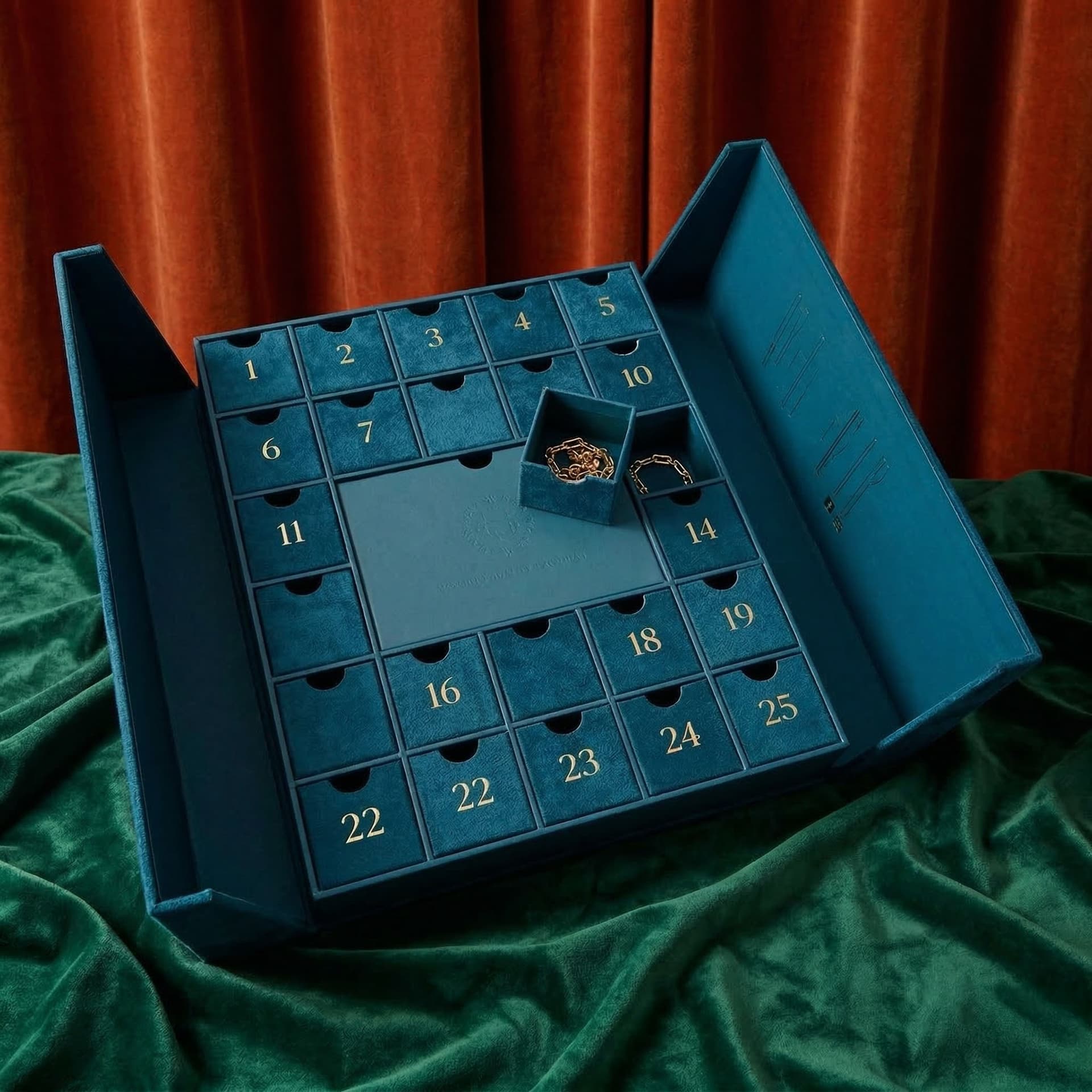
Individual drawers slide out from a rigid housing structure. Each drawer holds one product. The front face of each drawer is numbered.
Pros: Premium tactile experience. Each drawer creates its own reveal moment. Accommodates deeper products than door-style. Structurally impressive on camera for unboxing content.
Cons: Highest tooling cost of any advent format. Assembly is labor-intensive. Each drawer must slide smoothly after shipping and handling. Tolerance engineering is critical. If drawers stick or fall out, the calendar fails.
Typical cost: $16-25+ per unit at 2,000-5,000 units. Tooling alone can run $3,000-$8,000.
Magnetic Reveal
A rigid structure with magnetic closures on individual compartment lids or a single magnetic front panel that opens to reveal a grid of cavities. Combines the reveal drama of doors with the structural integrity of a rigid box.
Pros: Satisfying open-and-close mechanism. Magnets allow re-closing, which extends the life of the calendar as a display piece. Works well for higher-end products.
Cons: Magnet placement adds cost and complexity. Each magnetic closure must be calibrated. Too weak and the lid won't stay shut during shipping. Too strong and it's frustrating to open. Weight increases with magnet count.
Typical cost: $14-22 per unit at 2,000-5,000 units. Magnet hardware adds $0.50-$1.50 per compartment.
Tray-Based (Lift-and-Reveal)
A rigid outer shell with a removable or hinged lid. Inside, a multi-cavity tray holds all products in a grid layout, each covered by a numbered tissue, card, or paper seal. The customer lifts each cover to reveal the product.
Pros: Simplest assembly of any advent format. Lower tooling cost than drawers. Flexible cavity sizing. Good balance of premium feel and production efficiency.
Cons: Less dramatic reveal than doors or drawers. All products are technically visible once the lid is removed (just covered). Less “advent calendar” and more “gift set with numbered covers.”
Typical cost: $10-18 per unit at 2,000-5,000 units.
Advent Calendar Packaging Cost: What Drives the Price
Advent calendar packaging cost is a function of five variables. Understanding these before the brief stage prevents the sticker shock that derails projects in month three.
Component Count
A 24-door calendar has a minimum of 26 structural components: the outer shell, the inner tray or housing, and 24 individual doors, drawers, or covers. A drawer-style calendar can have 50+ components when you count drawer boxes, drawer sleeves, the housing frame, dividers, and the outer shell.
Every component needs its own die, its own material, and its own assembly step. More components always means higher cost.
Structural Complexity and Tooling
Tooling for a door-style calendar runs $1,500-$3,500. Drawer systems run $3,000-$8,000. Magnetic structures fall between the two. These are one-time costs amortized across the production run.
At 1,000 units, $5,000 in tooling adds $5.00 per unit. At 5,000 units, the same tooling adds $1.00 per unit. This is why volume matters disproportionately for advent calendars.
Insert Engineering
Every cavity in the calendar houses a different product. A skincare advent calendar might contain a 1 oz serum bottle, a 0.5 oz eye cream jar, a sheet mask sachet, a lip balm tube, a 2 oz cleanser bottle, and 19 other formats. Each cavity must be engineered to the specific dimensions of its product.
Insert materials affect cost:
- Die-cut card: $0.50-$1.50 per calendar. Budget option. Works for lightweight, uniform products.
- Thermoformed (vacuum-formed) tray: $2.00-$5.00 per calendar. Custom-molded to each product shape. Most common for beauty advent calendars.
- EVA foam: $3.00-$7.00 per calendar. Premium cushioning. Used for fragile glass products.
- Molded pulp: $1.50-$4.00 per calendar. Sustainable option. Works for moderate product weight.
The insert is where most first-time advent calendar projects hit problems. Product dimensions change during development. New SKUs get added or dropped. Each change means re-engineering the insert, which can mean new tooling.
Finishes and Materials
Finishes carry the same cost dynamics as other premium packaging, but multiplied across a larger surface area. A standard gift box has one lid and one base to finish. An advent calendar has a front panel, a back panel, side panels, and potentially 24 individual door or drawer faces.
For a detailed breakdown of finish costs and options, see our packaging finish guide.
Common finishes for holiday advent calendar beauty packaging:
- Soft-touch lamination across the full exterior: $0.30-$0.80 per unit (larger surface area than a standard box)
- Foil stamping on front panel and door numbers: $0.50-$2.00 per unit depending on coverage
- Embossing on the outer shell: $0.25-$0.60 per unit
- Interior print (full-color inside lid or behind doors): $0.40-$1.20 per unit
Volume and Run Size
Here's how per-unit pricing shifts across typical beauty advent calendar production runs:
- 500-1,000 units: $18-30+ per unit. Heavy tooling amortization. Best for PR programs or limited-edition drops.
- 1,000-3,000 units: $12-22 per unit. The range where most indie and mid-size beauty brands operate.
- 3,000-5,000 units: $8-18 per unit. Tooling spreads thin. Per-unit material and assembly costs stabilize. This is the sweet spot for DTC and selective retail.
- 5,000-10,000 units: $7-15 per unit. National retail volumes. Significant per-unit savings on labor-intensive formats like drawers.
The Production Timeline: Why You Need 6-8 Months
Beauty advent calendar production cannot be compressed into a summer project. Here's why each phase takes the time it takes.
Months 1-2: Brief, Format Selection, and Product Finalization
The brief must include final product dimensions for every item in the calendar. Not “approximately” — final dimensions. The insert can't be engineered until the products are locked. This is the phase most brands underestimate.
Build the brief using our packaging brief template to avoid the most common gaps.
Months 2-3: Structural Design and First Samples
Structural design, dielines for every component, and first prototype samples. The first sample is a white structural mock-up. No graphics, no finishes. Just the physical calendar with working doors, drawers, or reveals, fitted with the actual products (or dimensional stand-ins).
This sample answers the critical questions: Does every door open cleanly? Does every product fit? Is the structure rigid enough? Does it stand upright? Can it survive shipping?
Months 3-4: Graphic Design, Finish Samples, and PPS
Graphic design applied to structural dielines. Finish samples produced. Pre-production samples (PPS) created with final materials, printing, and finishes. This is the approval gate before mass production.
Months 4-6: Tooling, Mass Production, and Assembly
Final tooling. Mass production of all components. Assembly is typically hand work for advent calendars. Each unit requires loading 12-25 products into individual cavities, sealing doors or drawers, and final QC.
Assembly time per unit: 3-8 minutes for door-style, 8-15 minutes for drawer systems. At 3,000 units, that's 150-750 labor hours just for assembly.
Months 6-8: Freight, Kitting, and Delivery
Ocean freight (4-6 weeks for international production), customs clearance, warehouse receiving, final kitting, and outbound shipping to retail or DTC fulfillment.
For a complete production phase breakdown, see our concept to shelf timeline.
Retailer Compliance for Advent Calendar Sets
Advent calendars sold through retail channels face the same compliance requirements as standard holiday gift sets, plus additional considerations unique to the format. For GS1 barcode readiness, master-carton configuration specifics per retailer, and chargeback prevention, see our retail-ready beauty packaging guide.
Case Pack and Display Requirements
Advent calendars are large-format items. They don't fit standard shelf planograms. Most retailers merchandise them as endcap displays, promotional fixtures, or seasonal floor sets.
Case pack configurations must account for the calendar's dimensions and weight. A 24-drawer rigid calendar can weigh 2-4 lbs empty. Packed with products, it can exceed 5 lbs. Case packs of 4-6 units are common, and the master carton must protect the structure during distribution center handling.
Barcode and SKU Requirements
The advent calendar is its own SKU with its own UPC. Individual products inside the calendar typically do not need separate barcodes unless they're also sold individually. But if any products inside the set carry their own barcodes, placement must not interfere with the set's primary scannable code.
Sustainability Compliance
Advent calendars are sustainability-complex. Multi-material structures (rigid board, paper, magnets, foam inserts, plastic trays, ribbon) create end-of-life recycling challenges. Target, Sephora, and Ulta are all increasing pressure on packaging recyclability.
Design for mono-material construction where possible. FSC-certified board, paper-based inserts, and water-based coatings help. Molded pulp inserts replace thermoformed plastic trays at a similar cost point while improving recyclability.
Common Production Failures (and How to Avoid Them)
Having built advent calendars across dozens of beauty brands, we see the same failures repeatedly. None of them are design problems. They're process problems.
Product Dimensions Change After Insert Tooling
The insert is engineered to specific product dimensions. If the serum bottle changes from 1.1” diameter to 1.3” diameter after tooling, that cavity needs to be re-cut. At $200-$500 per cavity modification, changes across multiple products add up fast.
Prevention: Finalize all product dimensions before insert engineering begins. Use actual production samples, not 3D renders.
Starting Too Late
The most common failure. A brand decides in June to produce an advent calendar for November. Six months of work compressed into four. Structural sampling gets one round instead of two. Finish options narrow because there's no time for specialty materials. Assembly gets rushed. QC drops. The calendar ships with doors that stick, products that don't fit, or finishes that don't match the approved sample.
Prevention: Begin in January. No exceptions for complex formats.
Underestimating Assembly Time and Cost
Assembly is hand labor. A 24-drawer calendar takes 8-15 minutes per unit. At 3,000 units, that's 400-750 labor hours. Brands that budget for materials and tooling but forget assembly end up either over budget or under-assembled.
Prevention: Include assembly labor in the initial cost estimate. Budget $1.50-$4.00 per unit for assembly depending on complexity.
Structural Failure During Shipping
A beautiful calendar that arrives with warped panels, stuck drawers, or broken doors is worse than no calendar at all. Rigid structures need adequate board weight. Drawers need clearance tolerances that account for humidity changes during ocean freight. Doors need perforation engineering that allows clean opening without tearing the facing material.
Prevention: Ship test units through the actual distribution chain before committing to mass production. Test in the freight conditions the calendar will actually experience.
Advent Calendar Packaging FAQ
What to Do Next
If you've been asked to produce an advent calendar for this year's holiday season, the timeline starts now. The structural format, product lineup, and budget need to be defined before design can begin. We'll scope the project, confirm what's realistic for your timeline, and walk you through the format options that fit your product mix and price point.
Book a consultation to start scoping your advent calendar project.
*About the author: Jordan Harper is the founder of Logic Pac and Logic Agency, helping beauty and wellness brands design, source, and manufacture packaging from concept to delivery.*
Planning Holiday
Packaging?
Start now. We'll map the timeline backward from your retail ship date.