Gift Set Packaging Design: Structures, Inserts, and Cost Decisions for
Timelines, costs, and compliance
How should you structure gift set packaging?
Gift set packaging has four primary structures: rigid box with insert ($6–18/unit), folding carton with tray ($2–6/unit), sleeve + tray ($4–12/unit), and window box ($3–8/unit). Component count is the number one cost driver — jumping from 3 to 5 products can increase cost 30–50% because the insert gets more complex, the box gets larger, and assembly time increases.
Gift set packaging design starts with a structural decision: how do you hold 3-7 different products in a single box that looks intentional, protects everything during shipping, and meets the price point the margin requires? Multi-product gift set packaging is the second most common custom format we produce after standard cartons, and it's where the gap between “I want a beautiful box” and “here's what it actually costs to build” hits hardest.
The answer depends on three variables: how many products are in the set, how different their shapes and sizes are, and which channel the set ships through. A 3-product skincare routine in a rigid box with a custom insert is a different project than a 7-SKU discovery kit in a folding carton with a die-cut tray destined for Target's holiday endcap.
We design and manufacture custom gift set boxes for beauty and wellness brands across DTC, retail, and PR channels. This guide covers the structural approaches, insert options, cost drivers, and retailer requirements that determine whether a gift set project lands on budget and on time.
Key Takeaways
- The four primary gift set structures are rigid box with insert, folding carton with tray, sleeve + tray, and window box. Each carries different cost, perceived value, and production timeline tradeoffs.
- Component count is the #1 cost driver in gift set packaging. Every additional product, insert cavity, and structural element adds material, tooling, and assembly cost.
- Insert types range from $0.30/unit (die-cut card) to $5.00+/unit (custom EVA foam). The insert is what separates a gift set from products thrown in a box.
- Managing multiple product sizes in one kit requires insert engineering based on final product dimensions, not estimates. Dimension changes after tooling cost $200-500+ per cavity.
- Retailer display requirements (case pack, shelf dimensions, barcode placement) should be locked before structural design begins, not retrofitted after.
Structural Approaches for Multi-Product Gift Set Packaging
The structure is the first decision and the hardest to change later. Each approach carries a different cost profile, perceived value, production complexity, and suitability for different product counts and channels.
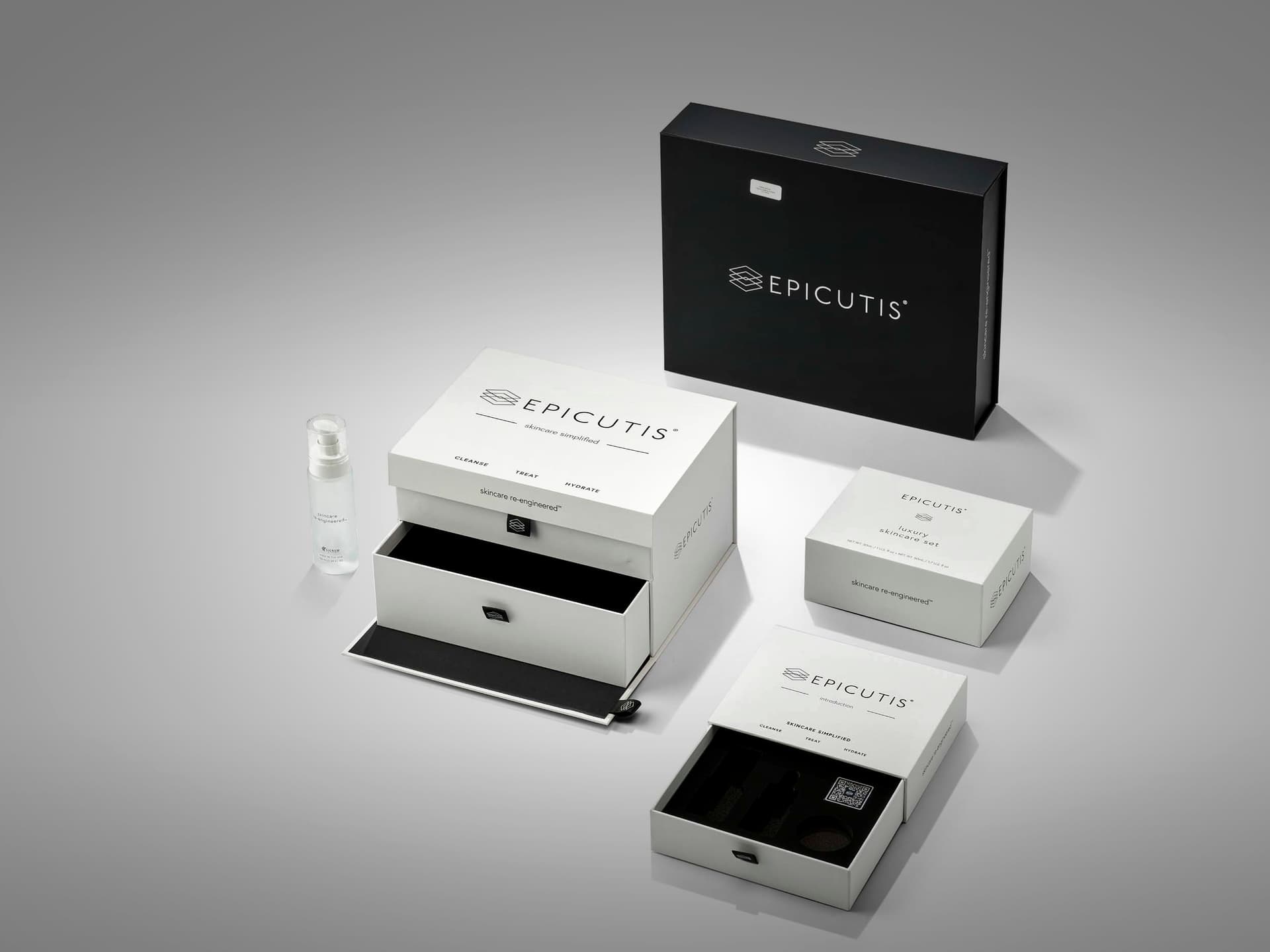
Rigid Box with Custom Insert
A two-piece rigid box (separate lid and base), paper-over-board construction, with a custom insert that holds each product in its own cavity. This is the premium standard for beauty gift box packaging.
Best for: Skincare routines (3-5 products), fragrance sets, premium color cosmetics. Retail price points above $40. Brands that want the lift-lid reveal moment.
Cost range: $6-18 per unit at 2,000-5,000 units, depending on size, insert material, and finishes. Tooling runs $1,200-$3,000.
Pros: Strongest perceived value. Clean reveal when the lid lifts. The insert cradles each product, creating a curated presentation. The rigid structure protects during shipping without additional void fill. Reusable by the customer.
Cons: Highest per-unit cost. Cannot ship flat (takes up warehouse space). Heavier than folding carton alternatives. Minimum 500-1,000 unit MOQ for custom builds.
Design considerations: Lid depth matters. A lid that's too shallow feels cheap and pops off in transit. Too deep and the products disappear inside the box. The sweet spot is a lid depth that reveals the top 40-60% of the tallest product when opened. Interior print on the lid underside adds a second brand moment at $0.20-$0.60 per unit.
Folding Carton with Tray
A single-piece folding carton (printed, die-cut, shipped flat, assembled at the warehouse) with an internal tray or platform that organizes the products. This is the cost-effective workhorse for multi-product gift set packaging at volume.
Best for: Discovery kits, value sets, retail-channel gift sets where cost efficiency matters. Product counts of 3-7 items. Price points of $20-$60.
Cost range: $2-6 per unit at 2,000-5,000 units. Tooling runs $800-$2,000.
Pros: Ships flat, reducing freight and storage costs. Lighter than rigid. Faster production timeline (10-14 weeks vs. 14-18 for rigid). Good print quality on coated SBS or kraft stocks. Recyclable as a mono-material structure.
Cons: Less premium feel than rigid. The structure flexes. Limited insert depth. Less dramatic unboxing moment. Products can shift if the tray fit isn't precise.
Design considerations: Board weight is critical. 18pt SBS is the minimum for a gift set carton that won't feel flimsy. 24pt is better for sets with heavier products. A platform insert (die-cut card that creates a raised floor) adds structure and keeps products upright. The tray should friction-fit inside the carton without rattling.
Sleeve + Tray
A rigid or semi-rigid tray that holds the products, wrapped by a printed sleeve that slides off to reveal the contents. The sleeve carries the graphics and branding. The tray holds the products.
Best for: Sets where the reveal sequence matters. The slide-off motion creates a slower, more intentional unboxing than a lift-lid. Works well for 2-4 products. Common in fragrance and prestige skincare.
Cost range: $4-12 per unit at 2,000-5,000 units. Two separate tooling charges (sleeve + tray): $1,500-$3,500 total.
Pros: The sleeve creates a dramatic reveal. The two-component system allows different materials for sleeve vs. tray (e.g., textured sleeve, smooth tray). Easy to add a belly band or seal for tamper evidence. The sleeve can be swapped for seasonal variants without re-tooling the tray.
Cons: Two components mean two production streams. The sleeve must fit snugly. Too tight and it's frustrating to remove. Too loose and it slides off in transit. The tray is visible from the sides once shelved, which limits display angles.
Design considerations: Sleeve tension is the engineering challenge. The fit should require deliberate effort to remove but not feel stuck. A 1-2mm tolerance on each side is typical. Soft-touch lamination on the sleeve exterior adds friction that improves the slide-off experience.
Window Box
A folding carton or rigid structure with a die-cut window (usually covered with clear PET film) that lets the customer see the products inside without opening the box. Common in retail environments where touch-and-feel isn't possible.
Best for: Retail gift sets where product visibility drives purchase. Color cosmetics sets where shade visibility matters. Impulse-price gift sets ($15-$35) where the customer needs to see what they're buying.
Cost range: $3-8 per unit at 2,000-5,000 units. Window die-cut adds $0.15-$0.40 per unit. PET film adds $0.10-$0.25 per unit.
Pros: Product visibility without opening. Reduces return rates (customer sees exactly what's inside). Effective on retail shelves where browsing is quick. Can highlight hero products through strategic window placement.
Cons: Window placement constrains graphic design layout. PET film adds a non-paper material (sustainability consideration). Products must look attractive through the window. Dust and fingerprints on the film reduce shelf appeal over time.
Insert Types: What Holds the Products in Place
The insert is what transforms a box with products inside it into a gift set. It's also where budget decisions have the biggest impact on perceived quality. Here's what each insert type costs and where it works best.
Die-Cut Card
A flat piece of printed card stock with die-cut holes or slots that hold products upright. The simplest and cheapest insert option.
Cost: $0.30-$1.00 per unit. Best for: Lightweight, uniform products (lip products, sachets, sample vials). Product counts of 3-5. Budget-conscious builds.
Limitations: No cushioning. Products can shift if holes aren't precisely sized. Doesn't work for heavy or oddly shaped items.
Thermoformed (Vacuum-Formed) Tray
A plastic tray custom-molded to the exact shape of each product. The most common insert for beauty gift box packaging.
Cost: $1.50-$4.00 per unit. Mold tooling: $500-$1,500. Best for: Mixed product sizes, glass bottles, heavy items. Any set where products vary significantly in shape and weight.
Limitations: Plastic material (PET or PVC) creates sustainability concerns. Not recyclable in most curbside programs unless made from RPET. Mold tooling means longer lead time than die-cut card.
EVA Foam
Closed-cell foam cut or routed to custom cavities. The premium insert option.
Cost: $3.00-$7.00 per unit. Best for: Fragile products (glass perfume bottles, ceramic), luxury price points, PR kits where the unboxing experience justifies the cost.
Limitations: Highest insert cost. Not recyclable. Heavier than other options. Best reserved for sets priced above $75 where the insert cost is proportional to the retail price.
Molded Pulp
Fiber-based trays molded from recycled paper pulp. The sustainable alternative to thermoformed plastic.
Cost: $1.00-$3.50 per unit. Mold tooling: $1,000-$3,000. Best for: Brands with sustainability commitments. Retailer programs that require recyclable packaging. Products that aren't fragile enough to need foam.
Limitations: Less precise fit than thermoformed plastic. Surface finish is rougher (though smooth-finish pulp is improving). Limited color options without secondary coating.
For a deeper comparison of materials and their sustainability profiles, see our material decision framework.
What Drives Gift Set Packaging Cost
Gift set packaging cost is driven by five factors. Understanding these before the design phase prevents budget surprises at the quoting stage.
Component Count (The #1 Driver)
Every product in the set adds a cavity to the insert, which adds tooling complexity and assembly time. A 3-product set might have 5 components (box, lid, insert, tissue, belly band). A 7-product set with a rigid box, custom insert, printed tissue, info card, and sleeve might have 10+ components.
Each component needs material, production, and an assembly step. The jump from 3 products to 5 products in a set doesn't increase cost by 66%. It can increase cost by 30-50% because the insert gets more complex, the box gets larger, and assembly time increases.
Structure Type
As outlined above, rigid boxes cost 2-3x more than folding cartons. Sleeve + tray falls between them. The structure choice has the largest single impact on per-unit cost after component count.
Finish Quality
One signature finish is almost always more cost-effective than three moderate finishes. A soft-touch lamination with a single foil-stamped logo creates a stronger impression than soft-touch plus spot UV plus embossing plus interior print. Each finish requires a separate production pass, and passes add cost.
Our packaging finish guide breaks down cost per finish and which combinations deliver the best value-to-perception ratio.
Volume
Per-unit cost drops meaningfully between 1,000 and 3,000 units, and again between 3,000 and 5,000 units. The improvement flattens above 5,000 units for most gift set formats. This is because tooling amortization is the biggest cost factor at low volumes, and it becomes negligible at higher volumes.
For a detailed cost breakdown by structure type, see our custom packaging cost guide.
Assembly and Kitting
Gift sets are assembly projects. Products arrive from the manufacturer. Packaging components arrive from the packaging supplier. Someone has to put them together. Kitting labor runs $0.75-$3.00 per unit depending on component count and complexity. This cost is often underestimated or omitted from initial budgets.
Managing Multiple Product Sizes in One Kit
The engineering challenge of multi-product gift set packaging is that no two products are the same size. A skincare routine might include a 1 oz serum bottle (tall, narrow), a 2 oz moisturizer jar (short, wide), a 0.5 oz eye cream (tiny), and a 4 oz cleanser (large). All four need to sit in the same box, held securely, looking intentional.
The Dimension Lock Rule
Finalize all product dimensions before insert engineering begins. Not “roughly this size.” Final production dimensions with tolerances. The insert is CNC-cut or mold-formed to specific measurements. A 2mm change in bottle diameter after tooling means a cavity that's either too tight (product won't fit) or too loose (product rattles).
Height Management
The tallest product determines box depth. Every shorter product needs either a raised platform in its cavity or a deeper cavity that conceals the product lower in the box. The visual goal is a consistent top line, where all product caps sit at roughly the same height when viewed from above. This requires different cavity depths for different products.
Weight Distribution
Heavy products (glass bottles, large jars) should sit near the center or back of the insert to prevent the box from tipping forward on shelf. Lightweight products (lip balms, sachets) can occupy edge positions. This sounds minor but affects retail shelf stability and shipping orientation.
Retailer Display Requirements
Gift sets sold through retail face display requirements that must be designed into the packaging from the start.
Shelf and Fixture Dimensions
Retailers assign gift sets to specific shelf positions or promotional fixtures. The box dimensions must fit the assigned space. A beautiful gift set that's 1” too wide for the shelf slot doesn't get displayed.
Get fixture specifications from the retailer's buyer or merchandising team before finalizing box dimensions. This is especially critical for holiday programs where gift sets are assigned to seasonal endcaps or floor displays with exact dimensional requirements.
Case Pack Compliance
Master carton configurations must meet the retailer's distribution center requirements. Case packs must fit their conveyor systems, meet weight limits, and align with PO quantities. A custom gift set box that's an awkward shape to case-pack adds cost and can trigger chargebacks.
The Shipping vs. Protection Tradeoff
Premium gift set packaging wants to be beautiful. Shipping logistics want it to be durable. These goals conflict.
Rigid boxes survive shipping well but are heavy and expensive to ship. Folding cartons are lighter and cheaper to ship but offer less protection. The solution is usually structural: a rigid insert inside a lighter outer carton, or a corrugated shipping sleeve over a premium inner box.
For DTC gift sets, the outer shipping box is part of the unboxing experience. For retail, the shipping carton is invisible to the customer but must protect the product through warehouse handling, truck transport, and store receiving.
Gift Set Packaging FAQs
What to Do Next
Gift set packaging design is a series of decisions that compound. The structure determines cost. The insert determines product fit. The finish determines shelf presence. The timeline determines whether you have room to get it right.
Start with the brief. Define the products, the target cost, the channel, and the quantity. That gives us enough to recommend a structure, quote realistic pricing, and map the production timeline. See how we developed gift set packaging for a growing skincare line in the Epicutis case study.
Book a consultation to scope your gift set packaging project.
*About the author: Jordan Harper is the founder of Logic Pac and Logic Agency, helping beauty and wellness brands design, source, and manufacture packaging from concept to delivery.*
Planning Holiday
Packaging?
Start now. We'll map the timeline backward from your retail ship date.