Luxury Jewelry Packaging Guide: When Premium Packaging Is Worth It
When premium packaging is worth the investment
When is premium jewelry packaging worth it?
Premium jewelry packaging pays for itself when the product retails above $200–500, is frequently gifted, sells through retail, or needs collection consistency across multiple formats. Most luxury jewelry boxes land at $6–15+ per unit at production volume, with complex gift sets reaching $15–25+. The goal is not the most expensive box — it is one that matches the precision of the piece inside.
Luxury jewelry packaging is worth the investment when the box supports a higher price point, a stronger gift experience, or a more consistent brand collection. For most jewelry brands, premium packaging means rigid construction, controlled materials, a precise insert, and one memorable finish — not a box overloaded with every expensive detail.
Key Takeaways
- Luxury jewelry packaging usually costs more because structure, lining, hardware, and finishing all matter at once.
- Premium does not mean complicated. One strong material and one controlled finish often look better than five effects.
- DTC and retail luxury packaging have different requirements: shipping protection vs. shelf or case presentation.
- The right investment depends on product price, reorder behavior, gifting frequency, and margin model.
- Gift sets and limited collections are often the best way to test a luxury packaging system before changing the core line.
Related reading: holiday packaging programs, packaging finishes guide, unboxing experience design guide, luxury beauty packaging guide, jewelry packaging page
What Makes Jewelry Packaging Feel Luxury?
Luxury is not one material. It is the way the system behaves. The box opens smoothly. The lid does not wobble. The insert holds the piece without friction. The material feels intentional. The logo is crisp. The customer can tell the brand cared before the jewelry is even removed.
The category has a high sensitivity to small failures. A slightly off foil stamp on a snack carton may be ignored. A crooked logo on a ring box carrying a $1,200 piece will be noticed. The packaging has to match the precision of the product.
Luxury packaging works when it creates confidence. Confidence in the piece, the gift, the brand, and the purchase.
When Should a Jewelry Brand Invest in Premium Packaging?
Premium packaging makes the most sense when the product is gifted often, when the retail price needs support, when the brand sells through retail, or when the collection has multiple formats that need to look unified.
If a product retails above $200–$500, packaging can either reinforce the value or create doubt. That does not mean every SKU needs a heavy rigid box. It means the package should not feel cheaper than the piece.
Retail adds another layer. Store teams handle the box before customers do. If the structure scuffs easily, the lid feels loose, or the collection looks mismatched in a display case, the package is working against the brand.
What Does Luxury Jewelry Packaging Cost?
Premium jewelry boxes typically land around $6–$15+ per unit at production volume, with luxury gift sets or complex rigid formats moving into the $15–$25+ range. Simple premium paperboard or sleeve systems can be lower, but they need exceptional print and finish control to feel luxury.
The cost is driven by board structure, wrap material, interior lining, cushion system, closure, hardware, and finish. Metal hinges, magnetic closures, plaques, velvet interiors, and specialty papers all add cost. So does quality control. Luxury packaging needs tighter tolerances because the product itself sets a high expectation.
The better question is not whether the box is expensive. It is whether the box is doing enough work to justify the cost. For a full pricing breakdown by format, see our custom jewelry packaging cost guide.
Which Structures Work Best for Luxury Jewelry?
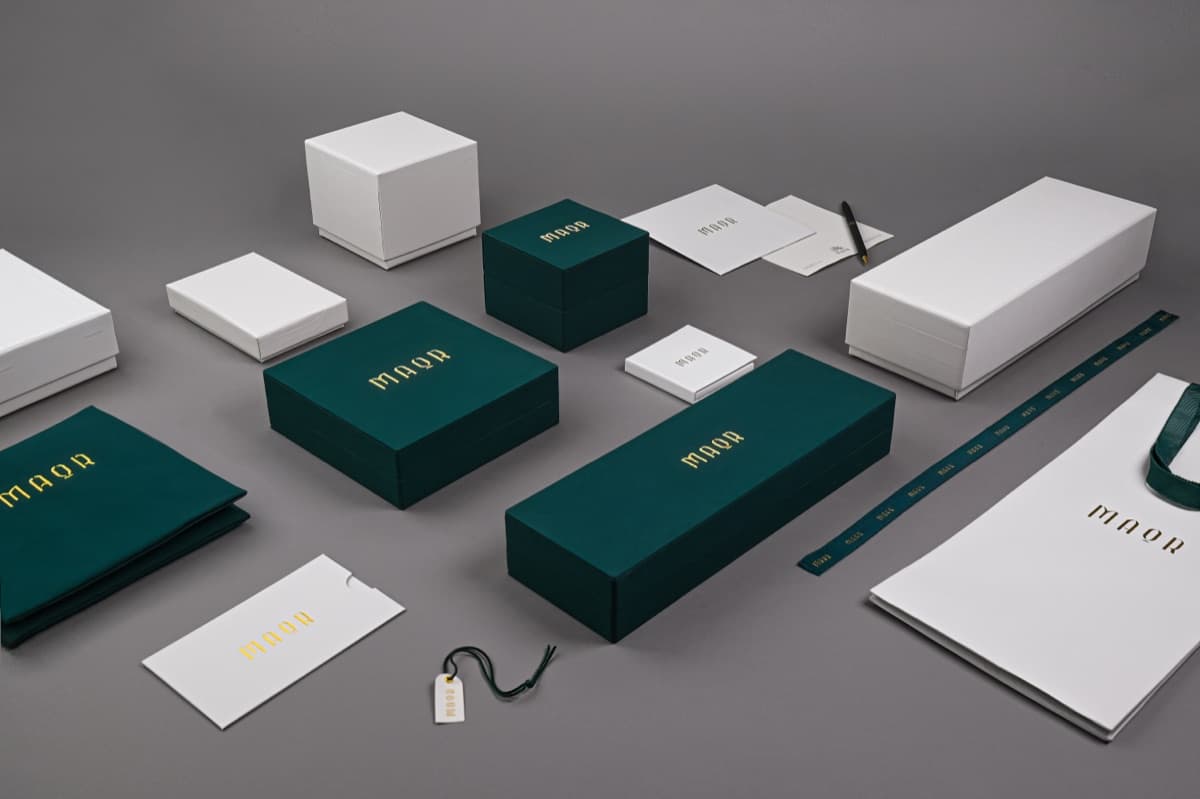
Hinged rigid boxes are the classic jewelry format because they create ceremony. Drawer boxes feel more modern and editorial. Book-style boxes work well for gift sets and storytelling. Lift-off boxes can feel clean and minimal when the material is strong enough.
The insert should be designed around the product, not borrowed from a catalog. Rings need upright support. Necklaces need anti-tangle control. Earrings need symmetry. Bracelets need enough space to avoid compression. A premium exterior cannot rescue a weak interior system.
For limited editions, a larger kit can create more brand surface area: care cards, polishing cloths, travel pouches, certificates, samples, or co-branded inserts. But every added item should earn its place.
What Finishes Should Luxury Jewelry Brands Use?
Foil stamping is the obvious fit because jewelry already uses metal cues. Gold, silver, champagne, rose gold, and black foil each create different signals. Embossing and debossing add tactility. Soft-touch coatings create a smooth hand feel for paper-wrapped formats. Specialty papers or linen wraps add texture without shouting.
The rule: one signature moment. A foil logo, a blind deboss, a soft interior reveal, or a colored lining can be enough. Stacking foil, spot UV, emboss, specialty paper, ribbons, plaques, and interior print can make a box feel busy instead of premium.
Luxury packaging is about control. Fewer decisions, executed better.
How to Test Premium Packaging Without Changing the Core Line
Do not start by replacing every box if the brand is already selling at volume. Start with a holiday gift set, collaboration kit, bridal collection, or limited-edition launch. That gives the team a contained project with clear quantities and a defined timeline.
A limited program reveals how the factory communicates, how samples look, how colors match, how freight behaves, and how the customer responds. Then the brand can decide whether to roll the system into the core line. Lower risk. Better information.
The ROI of Premium Jewelry Packaging
Premium packaging should create a business return. Sometimes that return is higher conversion. Sometimes it is fewer returns because the product arrives safely. Sometimes it is a stronger gift experience that drives repeat purchases. Sometimes it is retail credibility. The return has to be named before the package is designed.
For jewelry, the customer often buys emotion as much as material. Engagement, anniversary, graduation, bridesmaid gifts, holiday gifting, self-purchase milestones. The packaging frames the moment. If the box feels careless, the product has to work harder.
That does not mean the most expensive format wins. It means the packaging should support the promise the brand is already making. A minimal fine-jewelry brand may need restraint. A maximalist fashion-jewelry brand may need color and reveal. A bridal brand may need permanence. A trend-driven brand may need speed and flexibility.
Packaging That Customers Keep
A strong signal of luxury is whether the customer keeps the box. Kept packaging becomes storage, memory, and brand reinforcement. Disposable packaging can still be premium, but jewelry has a natural reason to live in packaging after purchase. That gives the box more value than it has in many categories.
Design for that afterlife. Does the ring box sit nicely in a drawer? Does the necklace card prevent tangling? Does the pouch travel well? Does the box feel too large to keep? Those questions change the format.
Retail Luxury vs. DTC Luxury
DTC luxury can build slowly. The customer opens the shipper, sees tissue, reads a note, opens the box, and finally sees the piece. Retail luxury has less time. The box may be handled by a sales associate or seen inside a case. It needs immediate clarity.
Retail also adds consistency pressure. Multiple box sizes in a retail environment need to look related at a glance. In DTC, a customer may only see one package. In retail, a buyer or store team sees the full line together. Inconsistency becomes obvious.
This is why premium jewelry packaging should be developed as a family. The ring box, necklace box, earring box, bracelet box, and gift set do not need identical structures. They need shared design logic. Our jewelry retail vs. DTC guide covers the specific differences by channel.
What Not to Spend On
Do not spend on materials customers cannot feel, see, or understand. Do not add hardware because it sounds premium if a magnetic closure would work better. Do not add a ribbon pull if the tray already lifts cleanly. Do not add a plaque if a foil stamp does the job.
Spend on fit. Spend on opening feel. Spend on color control. Spend on the insert. Spend on the finish that the customer actually notices.
The biggest luxury mistake is confusing expense with intention. The second biggest is copying old jewelry packaging codes without asking whether they fit the current brand.
How to Brief a Luxury Jewelry Packaging Project
A luxury brief should include price point, customer expectation, gifting frequency, sales channel, product dimensions, collection architecture, material preferences, finish preferences, sustainability boundaries, and the feeling the box should create.
Include what the brand is not. Not bridal. Not traditional. Not flashy. Not disposable. Those exclusions help suppliers make better recommendations. Luxury is often defined as much by what gets removed as what gets added.
Finally, include target landed cost. Without that number, the packaging team can design something beautiful and unusable. A premium box still has to work inside the margin model.
How Luxury Packaging Changes the Customer’s Perception of Value
Jewelry is already small. That creates a perception challenge. A customer may spend hundreds or thousands of dollars on an object that fits in the palm of their hand. Packaging helps the purchase feel complete.
Weight matters. Opening feel matters. The way the piece is held matters. The quietness of the design matters. A cheap insert can make a beautiful ring feel less considered. A loose hinge can make the brand feel less precise. A mismatched lining can make the product feel assembled instead of designed.
This is why luxury packaging should be evaluated as part of the product experience, not as a separate cost center. The box does not replace product quality. It frames it. When the packaging is right, the customer feels the value before they inspect the details.
The Risk of Overbuilding Luxury Packaging
Overbuilding is easy in jewelry. Add thicker board. Add magnets. Add ribbon. Add foil. Add a plaque. Add a pouch. Add a second insert. Suddenly the packaging costs too much, weighs too much, ships poorly, and distracts from the product.
The better path is controlled luxury. Choose the one moment that should feel expensive. Maybe it is the lining. Maybe it is the hinge. Maybe it is the foil. Maybe it is the way the ring rises in the insert. Make that moment excellent and keep the rest quiet.
Luxury packaging should never feel like it is trying to prove itself. It should feel inevitable.
How to Scale Luxury Packaging After the First Run
The first luxury packaging run should create standards the brand can repeat. Approved wrap. Approved lining. Approved foil. Approved insert fit. Approved carton packing. Those standards become the production language for future SKUs.
Without standards, every new piece becomes a new negotiation. The bracelet box comes out slightly warmer than the ring box. The necklace lining has a different nap. The gift set uses a different foil. None of those issues may look dramatic alone. Together, they make the brand feel less controlled.
The best luxury systems document the decisions once, then scale them across the collection. Our jewelry packaging design guide covers how to build that system from the ground up. That is how premium packaging becomes operationally useful instead of just beautiful.
Luxury Jewelry Packaging Guide FAQ
Build Jewelry Packaging That Matches the Product
Jewelry packaging carries more responsibility than most categories. It protects the piece, frames the value, and turns a small object into a complete brand experience. If you’re planning a new jewelry box, retail-ready format, seasonal gift set, or full packaging refresh, start with the structure, material, volume, and channel requirements before chasing finishes.
When you’re ready to pressure-test the direction, book a jewelry packaging consultation. We’ll give you a straight read on format, cost, MOQ, timeline, and what should be solved before the first sample is made.
Questions to Ask Before You Quote This Project
A jewelry packaging quote should answer more than unit price. Ask the supplier which material will be used, what the MOQ is by size, what tooling is required, how color will be matched across the full collection, how inserts will be approved, what freight method is assumed, and what happens if the production sample fails approval.
Ask for the landed-cost view, not just the factory cost. A box that looks cheaper before freight can be more expensive after dimensional weight, storage, rework, and rush shipping. Jewelry packaging is small, but it is often component-heavy. The more components in the system, the more important the quote discipline becomes.
Also ask who owns the final production checklist. The checklist should include material, color, lining, hardware, logo placement, insert fit, carton labeling, shipping carton specs, and acceptable defect tolerance. If those details are not defined before production, they become arguments after production.
How to Use This as a Packaging Brief
Turn the article into a brief before you ask for pricing. List the product formats, dimensions, materials, inserts, finishes, order quantities, launch date, sales channel, shipping method, and target landed cost. Then separate what is required from what is optional. Required items protect the product and brand. Optional items are where cost can be adjusted without damaging the experience.
For jewelry brands, the most important brief detail is the full collection map. A supplier needs to know whether this is one ring box or a system across rings, earrings, necklaces, bracelets, pendants, and seasonal kits. Without that map, the first sample can look good and still fail the collection.
Also include approval owners. Jewelry packaging often gets reviewed by founders, brand, product, retail, and operations. If those people review samples one at a time, the project slows down. If they review against the same brief, decisions get cleaner.
About the author: Jordan Harper is the founder of Logic Pac, a custom packaging development firm helping beauty, wellness, jewelry, and luxury goods brands design packaging that looks premium, protects the product, and works in production.
Ready to Start Your
Project?
Tell us your launch date and we’ll map the packaging timeline backward.