How Much Do Custom PR Kits Cost? A Tier-by-Tier Breakdown for Beauty Brands
Real costs, not estimates
How much does a custom PR kit cost per unit?
Custom PR kit packaging runs $8–15/unit for a basic branded mailer, $15–30/unit for a structured branded kit, and $30–75+/unit for a premium unboxing experience — all excluding product cost. The biggest cost lever is quantity: going from 50 to 500 units can cut per-unit cost by 40–60%. Brands consistently underbudget kitting labor ($1.50–5.00/unit) and shipping ($8–25/unit domestic).
Custom PR kit production cost ranges from $8-15 per unit for a basic branded mailer to $30-75+ per unit for a premium unboxing experience, not including the products inside. The total cost depends on five variables: quantity, structural complexity, insert type, finish quality, and kitting labor. At 500 units, a mid-tier branded kit typically lands at $18-25 per unit for the packaging alone.
Most beauty brands approaching their first PR kit have no frame of reference for what these things actually cost. They've seen the unboxing videos. They know they want “something like that.” But the distance between a corrugated mailer with tissue paper and a rigid box with custom foam inserts and foil stamping is $20-60+ per unit, and the right answer isn't always the expensive one.
We produce custom PR kits for beauty and wellness brands in runs of 50-5,000+ units from our Salt Lake City warehouse, handling design, sourcing, assembly, and fulfillment. This guide breaks down what each tier costs, what drives the price at each level, where brands overspend, where they underspend, and how to think about PR kit ROI.
Key Takeaways
- PR kit pricing falls into three tiers: basic mailer ($8-15/unit), branded kit ($15-30/unit), and premium experience ($30-75+/unit). Product cost is separate.
- Quantity is the single largest cost lever. The jump from 50 units to 500 units can reduce per-unit packaging cost by 40-60%.
- Kitting labor ($1.50-$5.00+ per unit) and fulfillment/shipping ($5-25+ per unit domestic) are the costs brands most commonly forget to budget.
- The ROI framework: if a $25 PR kit generates one social post with 50,000 impressions, the cost per impression is $0.0005. Paid media for the same audience costs 10-50x more.
- Brands overspend on structural complexity and underspend on the insert. The insert is what makes the unboxing moment work on camera.
Tier 1: Basic Branded Mailer ($8-15 per Unit)
The basic branded mailer is a custom-printed corrugated box or rigid mailer with branded tissue paper, a printed insert card, and the products inside. No custom structural engineering. No foam inserts. No specialty finishes beyond the print on the box.
What's Included
- Outer box: Custom-printed corrugated mailer or tuck-top box. Single-color or full-color exterior print. Standard E-flute or B-flute corrugated.
- Inner layer: Branded tissue paper or crinkle-cut fill. Printed card with product information, brand story, or influencer-specific messaging.
- Closure: Standard tuck, self-seal adhesive strip, or branded sticker seal.
Cost Breakdown at 500 Units
| Component | Cost per Unit | |–-|–-| | Custom printed mailer box | $3.50-$6.00 | | Branded tissue paper | $0.50-$1.00 | | Printed insert card | $0.30-$0.75 | | Branded sticker/seal | $0.20-$0.50 | | Kitting labor | $1.50-$2.50 | | Total (packaging only) | $6.00-$10.75 |
At 200 units, add 25-40% to the component costs. At 1,000 units, subtract 15-25%.
When This Tier Makes Sense
Basic mailers work for product seedings where the product itself is the star. If you're sending a single hero product to 500 micro-influencers, the packaging needs to protect the product and identify the brand. It doesn't need to be an experience. The product and the personal note do the work.
This tier also works for media sends where the journalist or editor is evaluating the product, not the box. A well-designed mailer with clean branding signals professionalism without overinvesting in packaging that gets recycled within minutes.
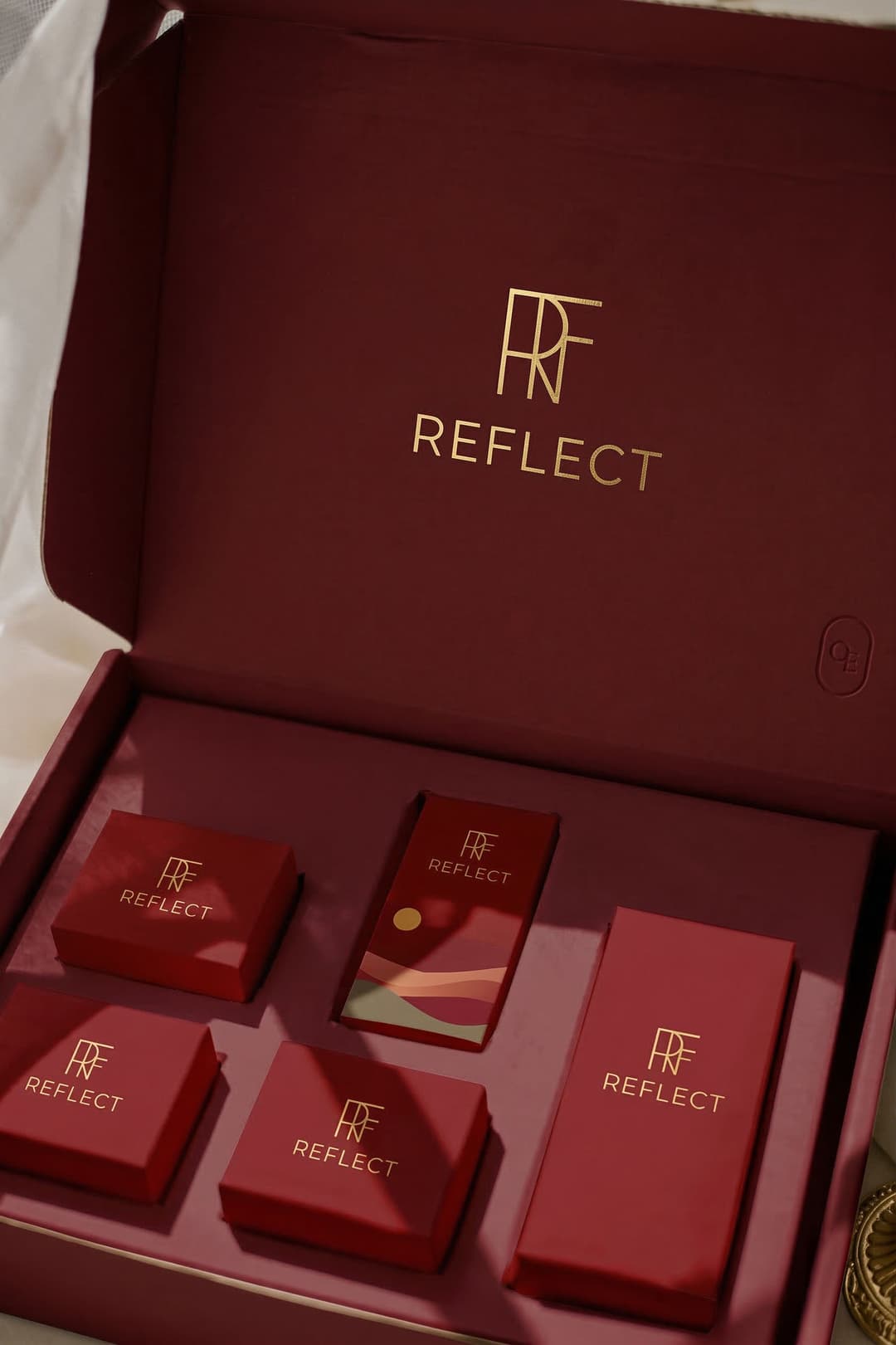
Tier 2: Branded Kit ($15-30 per Unit)
The branded kit adds structural intention and a curated unboxing sequence. This is where the packaging becomes part of the content. Most beauty PR kits that generate social posts live in this tier.
What's Included
- Outer box: Rigid setup box or premium folding carton. Soft-touch lamination, single foil stamp (logo), or spot UV on exterior.
- Insert: Die-cut card platform, thermoformed tray, or compartmentalized insert that holds each product in a specific position.
- Layering: Tissue, ribbon, or magnetic closure that creates a reveal sequence. The lid lifts to show products arranged deliberately.
- Collateral: Printed card with personalized messaging. Sometimes a branded item (canvas pouch, reusable bag, or accessory).
Cost Breakdown at 500 Units
| Component | Cost per Unit | |–-|–-| | Rigid or premium carton | $6.00-$12.00 | | Soft-touch lamination | $0.15-$0.35 | | Single foil stamp | $0.25-$0.60 | | Thermoformed insert tray | $2.00-$4.00 | | Tissue + ribbon | $0.75-$1.50 | | Printed collateral card | $0.40-$0.80 | | Kitting labor | $2.50-$4.00 | | Total (packaging only) | $12.05-$23.25 |
When This Tier Makes Sense
Branded kits are the sweet spot for most influencer PR campaigns in beauty. The packaging is designed to be opened on camera. The insert holds products in a photogenic arrangement. The finish quality says “this brand cares about details.” The total cost is manageable at run sizes of 100-1,000 units.
This is the tier where influencer kit cost starts to pay for itself in earned media. A $20 kit that generates a Stories post or Reel seen by 50,000-200,000 people is dramatically cheaper than the paid equivalent.
For a full guide on designing kits that get posted, see our influencer kit playbook.
Tier 3: Premium Experience ($30-75+ per Unit)
The premium experience tier is where the box itself becomes the content. These are the kits that get dedicated YouTube unboxing videos, TikTok posts with millions of views, and Instagram carousels with the box as the hero image. The packaging is designed as a brand artifact, not just a delivery vehicle.
What's Included
- Outer box: Rigid setup box with magnetic closure or drawer mechanism. Full exterior finish: soft-touch lamination + foil stamping + embossing or debossing. Interior print with brand pattern or messaging.
- Insert: Custom EVA foam or flocked tray, CNC-cut to each product's exact dimensions. Products nest into the foam and feel locked in place.
- Reveal sequence: Multiple layers. Outer magnetic lid opens to reveal a tissue layer or printed card. Beneath that, the foam insert with products. Sometimes a hidden drawer or second compartment with additional items.
- Extras: Custom ribbon pull, branded accessories (mirror, pouch, tool), personalized handwritten note, QR code linking to exclusive content.
Cost Breakdown at 500 Units
| Component | Cost per Unit | |–-|–-| | Rigid magnetic box with interior print | $12.00-$20.00 | | Soft-touch + foil + emboss | $1.00-$2.50 | | Custom EVA foam insert | $4.00-$7.00 | | Tissue + ribbon + card | $1.00-$2.00 | | Branded accessory | $2.00-$8.00 | | Kitting labor | $3.50-$5.00+ | | Total (packaging only) | $23.50-$44.50+ |
At 100-200 units (common for VIP sends), add 30-50% to component costs. Premium kits for major launches can exceed $75/unit when the box includes custom hardware, multi-drawer structures, or integrated electronics (LED lighting, sound modules).
When This Tier Makes Sense
Premium experience kits make sense for three scenarios: major product launches where the kit IS the marketing campaign, VIP sends to top-tier influencers (macro and mega) where the box needs to compete with every other brand sending them product, and press events where the kit serves as the physical centerpiece.
The math changes at this tier. You're not sending 500 of these. You're sending 50-200 to a curated list where each recipient has an audience of 100,000+. The cost per kit is high. The cost per impression, if the kit gets posted, is still a fraction of paid media.
The Costs Brands Forget to Budget
PR mailer cost conversations usually focus on the box. But the box is only 50-65% of the total per-unit cost. Here's what fills the rest.
Kitting and Assembly Labor
Every product, insert, card, tissue layer, ribbon, and sticker gets placed by hand. Kitting labor runs $1.50-$5.00+ per unit depending on component count and complexity.
A 3-product basic mailer: 2-3 minutes per unit. A 6-product premium kit with foam insert, tissue, ribbon, card, and accessory: 8-15 minutes per unit.
At 500 units and 10 minutes per unit, that's 83 labor hours. At $20/hour loaded labor cost, that's $3.32 per unit in assembly alone.
Fulfillment and Shipping
Shipping is the hidden budget killer for influencer kit cost calculations. Domestic shipping for a mid-size PR kit runs $8-18 per unit depending on weight, dimensions, and service level. Overnight or 2-day shipping (common for launch-timed sends) can hit $15-25 per unit.
International shipping for global influencer programs adds another layer: customs documentation, duties, and $25-60+ per unit for express international.
At 500 units with $12 average domestic shipping, fulfillment adds $6,000 to the program. That's often more than the packaging itself costs.
Design and Prototyping
Structural design and prototyping for a custom PR kit runs $500-$2,500 depending on complexity. This is a one-time cost, but it's real. If the design requires multiple sample rounds (common for premium builds), each additional round adds $300-$800.
Where Brands Overspend (and Where They Underspend)
After producing hundreds of PR kit programs, patterns emerge.
Where Brands Overspend
Structural complexity over substance. Drawers, hidden compartments, and multi-layer reveals are impressive, but they add $5-15+ per unit in structural cost and significantly increase assembly time. If the extra structure doesn't create a better on-camera moment, it's wasted budget.
Finishes on surfaces that don't show on camera. The bottom of the box, the back panel, and the inside of the base below the insert are invisible in unboxing content. Full exterior finishing on all six faces costs 40-60% more than finishing only the visible faces (top, front, sides).
Over-ordering. 500 premium kits at $30/unit is $15,000 in packaging alone. If the brand only has relationships with 200 influencers, 300 kits sit in storage. Right-size the run to the send list.
Where Brands Underspend
The insert. The insert is the single most important component for on-camera impact. Products arranged in a custom foam tray with visible branding look intentional and premium. Products rattling in crinkle fill look like a subscription box. Upgrading from crinkle fill to a thermoformed tray costs $1.50-$3.50 per unit and transforms the unboxing.
The reveal card or tissue. A printed tissue layer or branded reveal card that the recipient lifts before seeing the products creates a pause in the unboxing. That pause is what makes people reach for their phone. Cost: $0.40-$1.00 per unit.
Personalization. A handwritten note or printed card with the influencer's name costs nearly nothing but dramatically increases post rate. Influencers receive dozens of PR kits per month. The ones with personal touches get opened first.
For design strategies that maximize post rates, see our influencer kit packaging design guide.
The ROI Framework: PR Kit Cost vs. Earned Media Value
Custom PR box cost feels expensive in isolation. In context, it's one of the most efficient marketing spends available to beauty brands.
The Math
A Tier 2 branded kit costs $20/unit in packaging. Add $30 in products and $12 in shipping. Total: $62 per kit.
If that kit generates one Instagram post from an influencer with 100,000 followers:
- Impressions: 10,000-30,000 (typical for a Stories post or Reel from a mid-tier account)
- Cost per impression: $0.002-$0.006
- Equivalent paid media cost: CPM of $8-25 on Instagram = $80-$750 for the same impressions
- Earned media value: $80-$750 per post, conservatively
At a 30% post rate (30 out of 100 influencers post), 100 kits at $62/unit ($6,200 total) generate 30 posts. If each post averages 15,000 impressions, that's 450,000 impressions for $6,200. Cost per impression: $0.014. Paid media equivalent at $15 CPM: $6,750.
The PR kit program matches paid media cost at a 30% post rate. At a 50% post rate (achievable with proper targeting, personalization, and Tier 2 packaging), the ROI doubles.
What Improves Post Rate
Post rate is the variable that makes or breaks PR kit ROI. Three factors drive it:
1. Targeting: Sending to influencers who already use or discuss similar products. A kit sent to a skincare influencer who reviews Korean beauty will perform differently than the same kit sent to a lifestyle creator who rarely covers skincare.
2. Packaging quality: Kits that are camera-ready get filmed. Kits that require the influencer to arrange products for the shot don't. The insert does the styling work so the influencer doesn't have to.
3. Timing: Kits timed to a product launch, holiday season, or trend moment get prioritized. A random Tuesday arrival competes with every other package that week.
Our packaging finish guide covers which finishes photograph best and translate to camera.
PR Kit Cost FAQs
What to Do Next
Start with the send list. How many influencers, what tier of creator, and what's the occasion? The answers determine which packaging tier makes sense, what the per-unit budget should be, and whether the ROI math works.
We'll quote the packaging, map the timeline, and show you where to allocate budget for maximum post rate.
For a real example of the premium tier in production, see the Adidas Nemeziz launch kit case study.
Book a consultation to scope your PR kit program.
*About the author: Jordan Harper is the founder of Logic Pac and Logic Agency, helping beauty and wellness brands design, source, and manufacture packaging from concept to delivery.*
Need a Packaging
Quote?
Tell us what you need and we'll send real pricing — not a generic estimate.