Refillable beauty packaging: when the system works.
Refillables are the most-marketed sustainability play in beauty and the most-misunderstood. The honest version: refillability only delivers an environmental win when customers actually refill. Here's how to design systems that earn that adoption.
When does refillable beauty packaging work?
Refillable packaging works when customers repurchase often enough to reuse the primary pack and the refill is easier, less expensive, and operationally simpler than replacing it. It fails when the primary package becomes heavier and more complex without repeat adoption. Start with customer behavior and unit economics, then design the container, refill, and recovery path as one system.
What to know
- A refill is a repeat-purchase system, not just a packaging format.
- Hero SKUs with predictable replenishment are stronger candidates than occasional-purchase products.
- The primary pack and refill need compatible tolerances across production runs.
- Model adoption, component cost, channel behavior, and logistics before making an environmental claim.
01.The business case starts with reuse, not launch press
Three forces are converging in 2026 to make refillability a serious strategic question for beauty brands:
- Regulation. The EU PPWR (effective August 2026) introduces minimum reuse targets for certain packaging types and rewards systems that reduce single-use volume.
- Retailer pressure. Major beauty retailers — Sephora, Ulta, John Lewis, Selfridges — have all published packaging sustainability scorecards that score refillable systems higher than single-use.
- Category experimentation. Prestige brands have introduced refillable hero SKUs, creating useful operating examples without proving that every category or customer will adopt the model.
The strategic question for most brands isn't whether to introduce a refillable. It's which model, on which SKUs, with what infrastructure — and whether the math actually works.
- The three refillable models — and the supply chain each one demands
- When refillability earns its claim, and when it's worse than single-use
- Unit economics: the upfront premium, the refill margin, the breakeven point
- The adoption assumptions every brand should model before launch
- A decision framework for picking the right model for your category
02.The three refillable models
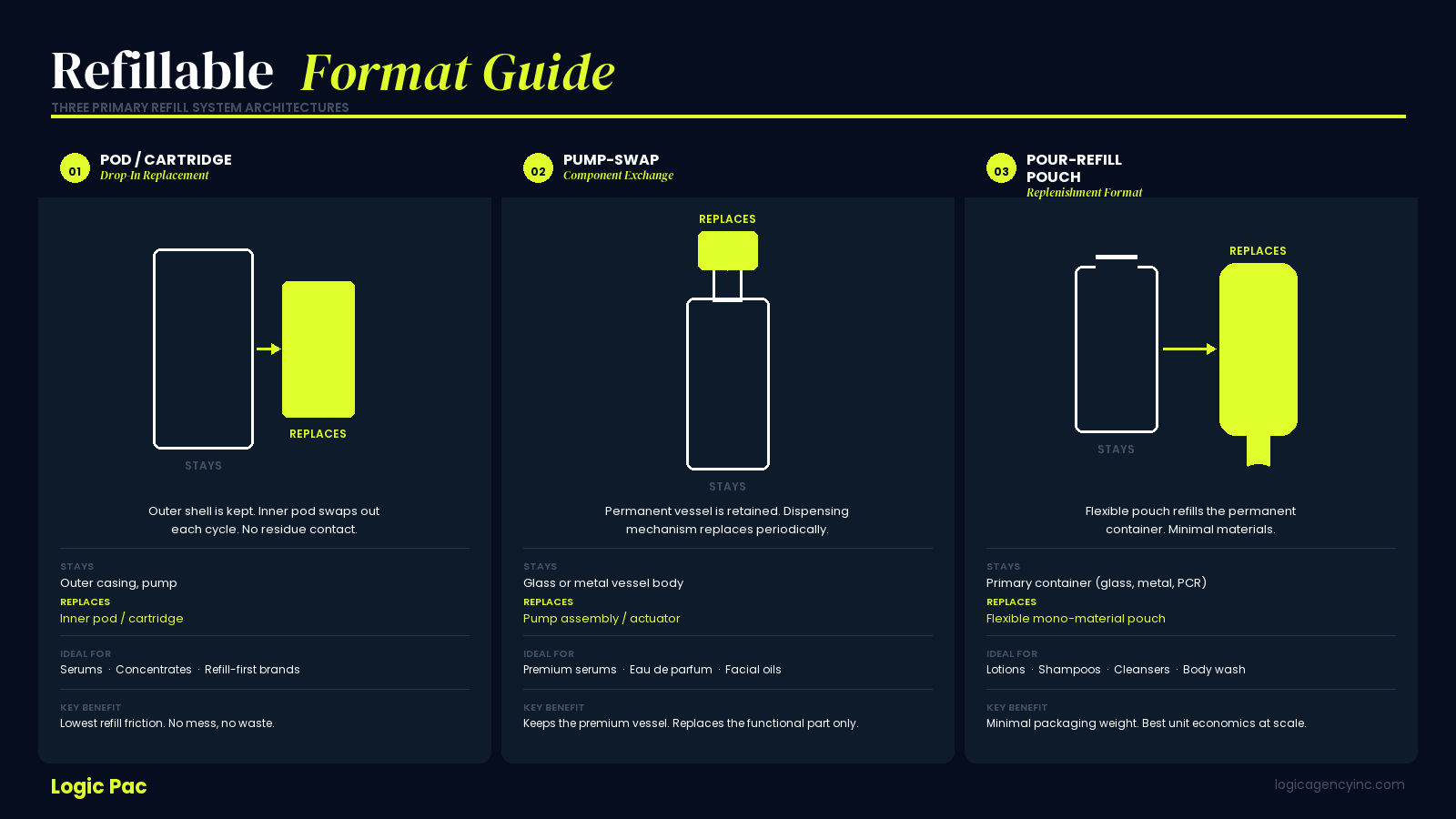
Model 1 · Drop-in refill
Customer keeps the primary container; replaces the formula. Most common in foundation, fragrance, deodorant, and prestige skincare. Customer purchases a refill cartridge or pouch.
- Examples: Hourglass Curator foundation, Chanel No. 5 fragrance refill, La Mer The Treatment Lotion refill
- Strength: highest per-refill margin lift, strong brand stickiness, cleanest sustainability claim
- Weakness: requires durable primary; refills must be perfectly compatible
Model 2 · Pod / cartridge swap
Customer keeps a base device or applicator; swaps a sealed pod or cartridge. Common in deodorant, mouthcare, color cosmetics.
- Examples: Wild deodorant, Bite toothpaste, Hourglass Confession lipstick
- Strength: hygiene-friendly, factory-sealed pods, easy retail SKU
- Weakness: pod itself is still single-use packaging; sustainability story depends on what the pod is made of
Model 3 · Bring-your-own / bulk fill
Customer brings the primary container back to a fill station (in-store or DTC return-and-refill). Common in indie beauty, body care, and low-volume prestige.
- Examples: Aësop in-store refill, Loop reusable systems, Plaine Products mail-back refill
- Strength: strongest theoretical sustainability footprint
- Weakness: hardest infrastructure to scale; consumer adoption is the bottleneck
03.When refillables work
Refillability earns its sustainability claim when the system delivers real reuse at meaningful scale. The conditions that have to be true:
- High repurchase frequency. If customers replace the product every 2–3 months, the refill economics work. If it's an annual purchase, the refill story is weak.
- Hero SKU loyalty. Refillables succeed inside loyal customer relationships. Trial-stage products fail at refill — customers want flexibility.
- Premium price point. The upfront primary container premium needs margin headroom. Mass-tier products rarely support the unit economics.
- Container durability. Glass or aluminum primaries last hundreds of refill cycles. Plastic primaries degrade and undermine the claim.
- Channel infrastructure. A refill SKU you can't keep in stock at retail is a refill SKU customers won't adopt.
04.When refillables are theater
Refillability becomes greenwashing when:
- The primary container is plastic and weighs more than two single-use units combined.
- The refill itself is a multi-material laminate pouch that can't be recycled.
- The product is a one-time or annual purchase (refill never happens).
- The refill SKU is unavailable, hard to find, or significantly more expensive than the original.
- The brand markets the system as “refillable” without disclosing the adoption rate.
A heavier primary container needs enough repeat use to justify its additional material and production impact. The required adoption level depends on component weight, durability, transport, cleaning or recovery, and the single-use package used as the baseline.
05.The unit economics
Below is a simplified model for a $48 retail prestige skincare SKU comparing single-use to a glass-primary refill system. Numbers are illustrative — your category will vary.
| Metric | Single-use | Refillable (glass primary + cartridge) |
|---|---|---|
| Retail price | $48.00 | $54 primary / $32 refill |
| Packaging cost (primary) | $1.40 | $3.20 |
| Packaging cost (refill) | — | $0.55 |
| Year-1 packaging spend (4 purchases) | $5.60 | $3.20 + (3 × $0.55) = $4.85 |
| Year-2 spend (assumes refill adoption) | $5.60 | 4 × $0.55 = $2.20 |
| Margin lift on refills (Year-2+) | — | Approx. 3–6 percentage points per refill |
| Breakeven on primary investment | — | ~2 refill cycles, conditional on adoption |
The math depends on adoption. Higher repeat use spreads the primary package cost across more purchases; low adoption leaves the brand carrying a more complex primary without recovering the investment. Model several adoption scenarios rather than treating a single threshold as universal.
06.What consumer behavior data tells us
- Adoption ceiling: mature refillable categories (fragrance, prestige skincare) are seeing 35–55% refill rates among brand-loyal buyers.
- Trial buyers do not refill. Customers who try a product as a one-off rarely return for a refill. Refill economics live inside loyalty programs and retention loops.
- Convenience drives adoption. Refills sold next to primaries, with subscription options and clear pricing, hit 2–3× higher adoption than refills hidden in DTC microsites.
- Price gap matters. The refill needs a clear value advantage over replacing the primary. Test the price difference against your margin, category, and customer behavior rather than assuming one universal discount.
07.Channel and retailer reality
Refillable systems behave differently across channels:
- DTC: easiest to launch, hardest to drive adoption. Subscription is your best mechanism.
- Sephora / Ulta: shelf real estate is the issue. Two SKUs (primary + refill) compete for one facing. Make the price differential immediately legible.
- Amazon: refills as a standalone listing struggle. Bundle with the primary on first purchase, then re-target refills.
- In-store fill / bulk: only works at scale at brand-controlled retail. Retail partners have not embraced bring-your-own systems.
08.Common pitfalls
- Refill SKU stockouts. If the refill is hard to buy, customers default back to a new primary and your sustainability claim collapses.
- Cartridge incompatibility. Customers expect refills to work with the primary they already own. Spec drift between production runs ruins that.
- Hygiene mistakes. Refillable systems for water-based formulas without preservation strategy can introduce contamination risk.
- Over-engineering the primary. Heavier, more decorative primaries undermine the carbon math. Premium feel ≠ heavier weight.
- Ignoring return logistics. Mail-back systems are romantic in theory and brutal in practice. Most brands abandon them inside 12 months.
09.The decision framework
Five questions, in order, before greenlighting a refillable program:
- Does this SKU have predictable repeat purchase? If not, the refill may struggle to earn enough reuse to support the model.
- Is your customer base brand-loyal at this SKU? If trial-heavy, refill economics break.
- Can your supply chain support a refill SKU at retail consistently? If stockouts are likely, don't launch yet.
- Can the primary survive repeated use? Durability, component weight, and the refill format all affect the environmental case.
- Can you publish actual adoption data? If not, you're not ready to make the public sustainability claim.
If you answered yes to all five, you're ready to design the system. If even one answer is no, you have a different problem to solve first — usually around customer retention, not packaging. For a case study in removing packaging complexity without weakening the brand, see the Artilect packaging reduction.
Bottom line
Do not start with the most beautiful refill mechanism. Start with the product customers already replenish, the adoption needed to support the model, and the channel that can explain and stock the system. If those pieces do not hold, solve the repeat-purchase problem before adding packaging complexity.
Still Have Questions?
We help beauty brands separate the refill systems that actually deliver from the ones that look good in a press release — and design programs that customers, retailers, and regulators all accept.
Refillable System FAQs
Test the Refill Model
Before Engineering
We can compare refill formats against your SKU economics, customer behavior, channel, quantities, and manufacturing constraints.