The custom packaging timeline, phase by phase.
A realistic schedule for discovery, design, prototypes, testing, production, quality control, and freight.
How long does custom packaging take?
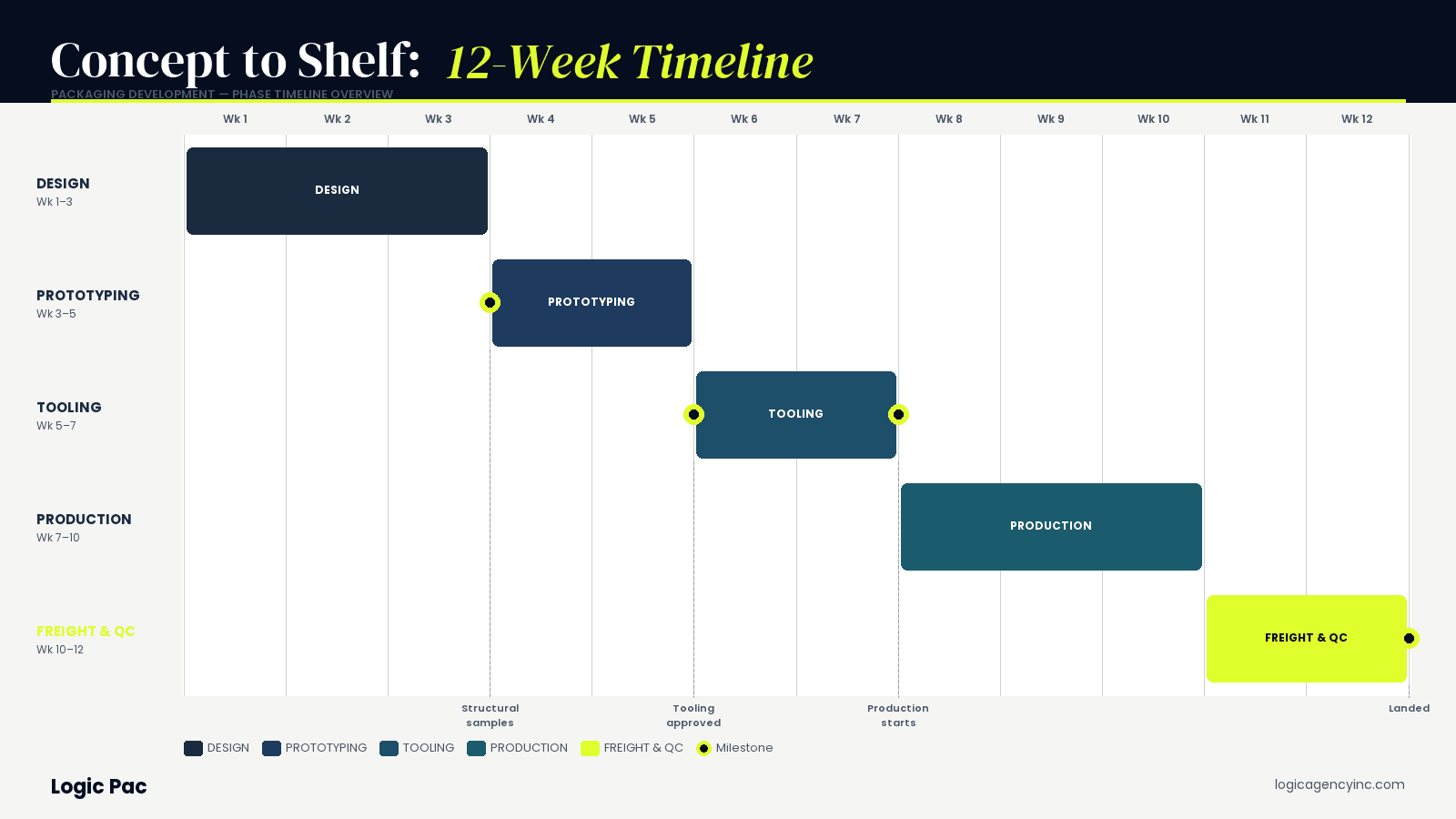
A 12-week custom packaging program is possible for a tightly defined project with fast approvals, proven materials, available capacity, and a freight plan that fits the deadline. More complex structures, new tooling, repeated sampling, testing, or ocean freight extend the schedule. The timeline is protected in the brief and approval process long before production begins.
What to know
- The first two weeks determine whether later phases stay on schedule.
- Structural decisions must be resolved before artwork and finish approvals lock.
- Test the real product inside the prototype—not an empty package.
- Separate production time from freight time when setting the launch date.
01.Most delays begin before the production order
Every packaging project has the same six phases. The brands that hit shelf on schedule don’t move faster — they make decisions earlier and respect the dependencies between stages.
Here’s the pattern we see across hundreds of projects: delays don’t come from production. They come from indecision in the first four weeks. One material change in week 7 can push your launch by a month. One unclear brand brief in week 1 can compound into three rounds of redesign before sampling. Our custom packaging timeline article covers the phase-by-phase cost of delays.
This guide breaks down what actually happens in each phase, what kills the timeline, and what you can do upstream to protect a 12-week launch window.
- Phase-by-phase breakdown of what happens, what to expect, and what kills the timeline
- The seven decisions that compress a project — and the five that extend it
- A phase-gate checklist your team can use to validate readiness at each stage
- FAQs on rush options, parallel processing, and when 12 weeks isn’t realistic
02.Weeks 1–2 · Discovery & Briefing
This is where everything gets defined. Materials, sustainability requirements, budget parameters, brand guidelines, distribution channels, performance specs, and the shelf context the package needs to compete in.
What it looks like: stakeholder meetings, brand questionnaires, technical spec documentation, target sample collection. Nothing physical happens. It’s all alignment.
What kills this phase: rushing it. Most brands try to compress weeks 1–2 because “we already know what we want.” Then they rebrief in week 5 when prototypes don’t match the original vision, and the project loses 3 weeks. Use our packaging brief template to lock these decisions upfront.
The single highest-leverage decision in a 12-week timeline is how much rigor you bring to the first 10 days.
03.Weeks 3–4 · Design & Concept Development
Your designer is sketching, rendering, and exploring multiple structural and graphic directions. Working through how the design behaves in 3D, photographs, and survives a crowded shelf. Multiple concepts get refined to two or three directions for stakeholder review.
What you’re deciding: structure, primary palette, typography, finish strategy, opening mechanism. Color separations and special finish die plans get locked.
Common pitfall: approving “design direction” without resolving the structural decisions. A beautiful flat render that hasn’t been tested against actual product fit will fail at the prototype stage.
04.Weeks 5–6 · Prototyping & Structural Engineering
The design isn’t just beautiful — it has to work. This phase produces structural prototypes, validates fold lines and closure mechanics, and tests material performance. Embossing or special finish die tooling is created. Color match drawdowns happen on actual substrates.
What you’ll see: first physical samples, often hand-built, sometimes 3D-printed. They’re rough. They’re not meant to be pretty — they’re meant to validate that the design is producible.
Don’t skip: putting your actual product into the prototype. Empty packaging always fits. Filled packaging is where you find the issues.
05.Weeks 7–8 · Sampling & Testing
First samples come off the production tooling. You’re evaluating color match, finish quality, structural durability, label registration, and how your actual product feels inside the packaging at production-grade quality.
Adjustments happen here. A second sample run might be needed. Drop tests, moisture testing, or compression testing happen on schedule. This is the last window to make changes before production tooling locks.
06.Weeks 9–10 · Production Setup & QC
Tooling is finalized. Your manufacturer prepares production runs. Artwork approvals lock. Material sourcing confirms. Trial runs test for consistency. QC parameters are documented.
This is the phase that prevents disasters at scale. Brands that skip a press check or trial run are the ones who discover color drift, registration issues, or finish defects in week 12 — when there’s no time to fix them.
07.Weeks 11–12 · Delivery & Final QC
Production runs at volume. Quality audits happen on output. Final product is inspected, packed, and shipped to your warehouse, fulfillment center, or retail DC. Delivery timelines vary by geography — domestic ground freight is 3–5 days; ocean freight from Asia is 4–6 weeks (plan that into your overall window).
08.What compresses the timeline — and what extends it
| What compresses | What extends |
|---|---|
| Pre-locked design direction — you already know your brand aesthetic | Mid-project material change — adds 3–5 weeks per change |
| Existing material library — you’ve tested what works in your category | Stakeholder indecision — every revision round adds 5–7 days |
| Simplified structure — fewer custom finishes mean faster tooling | Custom material specifications — extends sourcing 2–4 weeks |
| Domestic / regional production — shorter shipping times | International freight — adds 4–6 weeks ocean transit |
| Parallel-processing partner — design + tooling + sourcing in parallel | Sequential workflow — each phase waits for prior approval |
| Brief discipline — comprehensive Week-1 documentation | Regulatory compliance changes — material sourcing pivots |
| Pre-vetted suppliers — no RFQ cycles needed | Sustainability requirement added mid-project — full restart |
09.The phase-gate checklist
Use this at the end of each phase. If you can’t answer yes to every item in a gate, don’t move forward — the cost of fixing it later is higher than the cost of waiting now.
Gate 1 (end of Week 2) — Brief lock
- Materials, finishes, and structural format are documented
- Sustainability requirements are explicit (PCR %, certifications, regulatory jurisdictions)
- Distribution channels are confirmed (retail, DTC, both — each affects spec)
- Budget per unit and per project is approved
- Stakeholder approval chain is mapped
Gate 2 (end of Week 4) — Design lock
- Final structural design selected and tested for product fit
- Color palette specified by substrate (not just by Pantone)
- Finish strategy committed (matte, soft-touch, foil — and where)
- Print files prepared to spec
Gate 3 (end of Week 8) — Sample approval
- Production-grade sample matches design intent
- Color drawdowns approved across all substrates
- Drop, compression, or moisture tests passed
- Product fits, dispenses, and seals correctly
For a real-world example of this timeline executed across a growing SKU portfolio, see the Epicutis packaging program case study.
Bottom line
Speed comes from fewer late decisions, not less diligence. A clear brief, named approvers, defined testing, and an agreed freight plan do more to protect launch timing than asking production to move faster after the project has drifted.
Still Have Questions?
Most brands lose weeks because the brief was too thin to hold its shape under design pressure. We help you lock the brief, choose the right structural format, and route the work to suppliers who can deliver — without rebriefing in Week 5.
Packaging Timeline FAQs
Hit the
Timeline
Twelve weeks is realistic — if you start with the right brief. Let's build yours.