How to choose the right beauty packaging material.
Glass. PET. HDPE. Aluminum. Molded fiber. Every beauty packaging project starts with the same five-way material call — and most brands make it on aesthetics alone. Here's how to make it the right way.
What should determine a beauty packaging material?
Choose packaging material by working outward from the formula and channel—not inward from a mood board. Glass, PET, HDPE, aluminum, and molded fiber each change product compatibility, freight, breakage risk, minimums, decoration, recyclability, and shelf signal. The right material protects the product and fits the operating model while still carrying the brand.
What to know
- Formula compatibility and product protection are the first filters.
- Freight, breakage, and minimums can change the real cost more than the quoted unit price.
- Material and closure decisions must be evaluated as one system.
- Premium perception comes from structure, proportion, finish, and execution—not weight alone.
01.Material sets the rules for everything downstream
You can change colors, fonts, finishes, even structures — within reason — without rebuilding your supply chain. You can't change the material without changing everything downstream. Cost. MOQs. Lead times. Recyclability. Compliance. Shelf weight. Freight. Customer perception.
The brands that get this right treat material as a strategic decision made in concept stage, with full input from product, brand, ops, and finance. The brands that get it wrong treat it as a follow-on detail handled by the packaging supplier.
This guide breaks down the five core material families used in beauty, what each one delivers, when each one fails, and how to choose by product category, channel, and stage.
- The five core materials and what each one actually delivers
- A decision matrix by category — skincare, color cosmetics, fragrance, haircare
- Cost and MOQ ranges so you can model unit economics before you commit
- Sustainability scoring across the materials (the honest version, not the marketing)
- How perception, regulation, and supply chain interact in real decisions
02.The five core materials
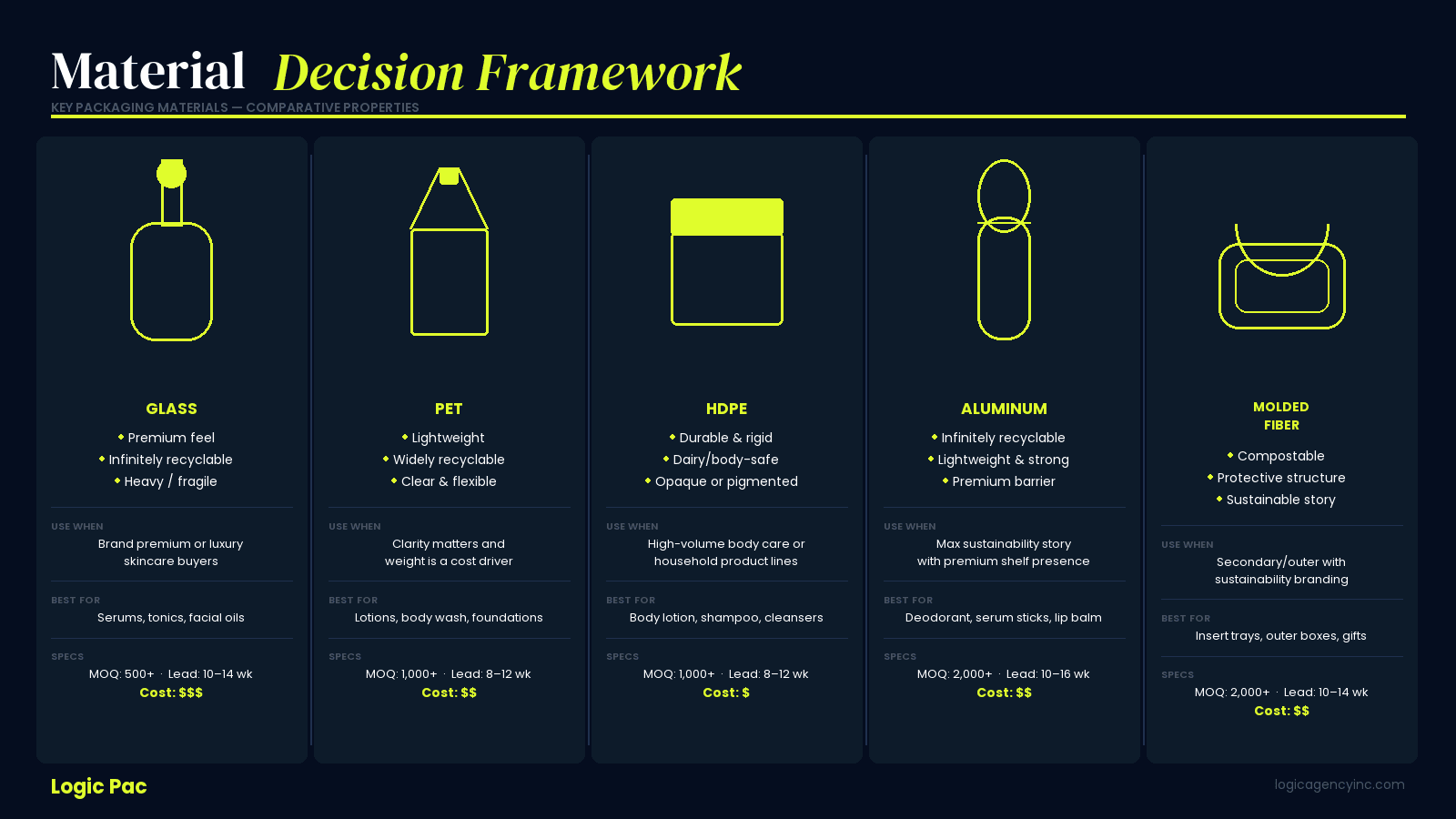
Glass
Heavy, premium-positioned, recyclable where accepted, breakable, and freight-intensive. Glass is common for serums, fragrance, and some refillable systems, but the full package and local recovery infrastructure determine the real outcome.
Where it works: hero SKUs, fragrance, prestige skincare, refillable bases.
Where it fails: high-volume DTC (breakage + freight emissions), travel formats, value tiers. For the full side-by-side comparison, see our glass vs. plastic beauty packaging article.
PET (Polyethylene Terephthalate)
Clear, lightweight, durable, and available with PCR content. PET is a common material for clear bottles and jars, with recovery dependent on color, format, closures, labels, and local infrastructure.
Where it works: clear-format products where you want product visibility, mid-tier skincare, haircare, body.
Where it fails: luxury positioning where weight signals quality. Heat-sensitive formats (lower thermal resistance than HDPE).
HDPE (High-Density Polyethylene)
Opaque, chemically resistant, slightly less premium than PET. The go-to for haircare, body, opaque skincare, and any product where chemical compatibility matters more than visual product visibility.
Where it works: shampoo, conditioner, body wash, opaque cleansers.
Where it fails: brand positioning that demands a more refined surface or feel. Our HDPE vs. PET comparison covers the chemical resistance and clarity tradeoffs in detail.
Aluminum
Light, premium-positioned, and recyclable where accepted. Aluminum is used in deodorants, fragrance, and refillable formats, but coatings, pumps, closures, and local recycling systems still need to be evaluated.
Where it works: deodorant, refillable bases, prestige skincare, fragrance, products where the package itself becomes the brand asset.
Where it fails: products that need transparency (you can't see the formula). Reactive formulations (some require interior coatings).
Molded Fiber
Made from paper pulp reformed under heat and pressure. Molded fiber can use recycled or certified feedstock and works well for protective inserts when its coatings and end-of-life path match the intended claim.
Where it works: inserts, structural protection, e-commerce mailers, gift sets, premium boxes — anywhere you'd previously use plastic clamshells or foam.
Where it fails: primary packaging for liquids without a polymer barrier. Products that need a hermetic seal.
03.The decision matrix — by category
Different beauty categories have different physical requirements, perception expectations, and channel constraints. Here's where each material lands by category.
| Category | Default | Premium | Sustainable | Avoid |
|---|---|---|---|---|
| Prestige Skincare | Glass jar / PET dropper | Glass + aluminum closure | Refillable glass + aluminum | Single-use clear PET (perception) |
| Mass Skincare | PET / HDPE bottle | Mono-PE tube | 50%+ PCR PET | Multi-layer films, mixed resins |
| Color Cosmetics | Aluminum or coated PP compact | Refillable aluminum | Magnetic refill systems | Throwaway plastic compacts |
| Fragrance | Glass with metal collar | Hand-finished glass + decorative cap | Refillable glass + concentrated atomizer | PET (kills perception) |
| Haircare | HDPE bottle | HDPE with soft-touch label | Mono-PE bottle + cap, 50% PCR | Multi-resin pumps |
| Body | HDPE / PET bottle | Glass jar (premium tier) | Aluminum tube + refill | Mixed-material airless |
| Deodorant | Plastic stick | Aluminum stick or refillable case | Cardboard tube or aluminum refill | Aerosol (regulatory exposure) |
04.Cost & MOQs by material
Per-unit numbers below are typical ranges at production volume (10K+ units). Smaller runs add 30–80% to per-unit cost. Tooling and decoration are extra.
| Material | Typical Per-Unit | Standard MOQ | Lead Time | Tooling |
|---|---|---|---|---|
| Glass (stock) | $0.40 – $1.20 | 5,000–10,000 | 4–8 weeks | None for stock; $5–25K custom |
| Glass (custom) | $1.50 – $5.00+ | 30,000–50,000 | 10–16 weeks | $15K–60K mold |
| PET | $0.10 – $0.45 | 10,000+ | 3–6 weeks | $3K–15K (custom) |
| HDPE | $0.08 – $0.35 | 10,000+ | 3–6 weeks | $3K–15K (custom) |
| Aluminum | $0.45 – $2.50 | 5,000–25,000 | 6–12 weeks | $5K–30K depending on form |
| Molded Fiber | $0.15 – $0.75 | 10,000+ | 8–12 weeks | $5K–15K mold |
The cheapest material at the production line isn't always the cheapest material at landed cost. Glass freight, aluminum scrap rates, and molded fiber lead times all change the equation.
05.Sustainability scoring (the honest version)
Every material has a sustainability story brands love to tell. Here's the version that actually holds up under regulatory or analyst scrutiny.
| Material | Recyclability | Real-world recovery | Carbon footprint | EU PPWR readiness |
|---|---|---|---|---|
| Glass | Infinite, in theory | ~33% (US); 70%+ (EU) | High (heavy, energy-intense) | Compliant when mono-material |
| PET | High | 29% (US); much higher EU | Lower at recycled content | 30% rPET mandate by 2030 |
| HDPE | High | 29% (US); higher EU | Lower than PET | 10% recycled content mandate |
| Aluminum | Infinite, in practice | ~50% (US); ~75% (global) | High at virgin; low at recycled | Compliant when mono-material |
| Molded Fiber | Yes (paper stream) | High where unconstrained | Low at recycled feedstock | Compliant; FSC adds credibility |
06.Perception signals — what each material says
Material is one of the strongest non-verbal brand signals in beauty. Most consumers can't name the material, but they read it instantly through weight, finish, and tactile feedback.
- Glass signals: heritage, prestige, efficacy, “real”
- Aluminum signals: modern, premium, refillable, intentional
- PET (clear) signals: clean, fresh, pharmacy, accessible
- HDPE signals: workhorse, value, mass — unless dressed up
- Molded Fiber signals: natural, sustainable, considered
The brands that win premium positioning use material to do the brand-equity work that decoration alone can't. The brands that miss it spend twice on graphics trying to compensate for a material that signals the wrong tier.
07.Supply chain reality — what your material choice locks in
Material isn't just a unit-cost decision. It's a supply chain decision. Here's what each one commits you to:
- Glass ties you to fewer global suppliers, longer lead times, and a freight model that punishes you on DTC volume.
- PET / HDPE open up the largest, most flexible supplier base — but commodity pricing is volatile.
- Aluminum requires specialty tooling, decoration partners (anodizing, printing), and longer lead times.
- Molded Fiber means a smaller supplier pool and longer tooling cycles, but stable pricing and strong sustainability story.
08.The decision framework
If you're picking a material today, run the brief through these five questions in order:
- What does the formula require? Light-sensitive, heat-sensitive, oil-based, alcohol-based — each rules out certain materials.
- What price tier are you positioning at? Material is your strongest perception lever.
- What's your channel mix? DTC freight realities differ from retail planogram rules.
- What's your volume profile? Custom tooling justifies at scale; stock formats win at lower volume.
- What sustainability commitments have you made? Public claims need supply-chain evidence.
If any of those answers are unclear, you're not ready to pick a material yet. You're ready to ask better questions. See how material decisions drove a packaging reduction program in the Artilect case study.
Sources
External regulatory standards, recycling data, and market figures referenced in this guide. Pricing, MOQ, and lead-time ranges are Logic Pac's own sourcing data and are presented as guidance, not citation.
- EU Packaging and Packaging Waste Regulation (PPWR) — effective August 2026. Mono-material requirements, recycled-content thresholds, EPR fee schedules driving material penalties for multi-layer formats.
- U.S. EPA — Plastics Material-Specific Data — PET bottles 29.1% recycling rate, HDPE natural bottles 29.3%, broader plastic packaging 13.3%.
- FSC 2025 Global Consumer Recognition Survey — Ipsos for Forest Stewardship Council. 46% recognition across 33 countries; 62% prefer FSC-certified.
Bottom line
There is no universally best packaging material. There is a best-fit material for a specific formula, price point, channel, volume, and brand position. Eliminate options that fail product protection or operating economics first. Then make the design decision inside the viable set.
Still Have Questions?
Here are the most common questions we get about packaging materials. If you don't see your question, book a call and we'll give you a straight answer.
Material Decision FAQs
Narrow the Material Set
Before Sampling
Share the formula format, channel, target quantity, price position, and sustainability requirements. We can identify which paths deserve a sample and which may create avoidable cost or supply risk.