The packaging brief template that keeps projects moving.
A clear brief moves decisions upstream and reduces avoidable rework. This guide is based on the briefing structure we use with clients—the ten sections a useful brief should contain and the omissions that commonly delay design, quoting, and approvals.
What belongs in a packaging brief?
A useful packaging brief resolves the decisions suppliers, designers, engineers, and approvers need before development starts. It should define the product, objective, channel, sustainability requirements, target cost, quantity, timeline, performance needs, deliverables, and approval owners. The goal is not a long document. It is fewer expensive decisions arriving late.
What to know
- Name the business objective and distribution channel before discussing aesthetics.
- Include target quantity and cost so proposed structures are commercially relevant.
- Define performance, testing, and sustainability requirements in the first brief.
- Assign final decision owners and response deadlines for every approval stage.
01.A strong brief moves decisions upstream
Every packaging project has a finite number of decisions that need to be made. The brief is where they get captured. The more decisions resolved on day one, the fewer resurface in week six — when fixing them costs real time and money. The sections below cover the ten brief fields that matter and the common omissions that drive the most expensive late-stage changes.
The length does not determine the quality of a brief. What matters is whether it answers the questions the design, engineering, sourcing, and approval teams need to resolve early.
The cost of a 30-minute conversation in week one is approximately zero. The cost of the same decision in week six is two weeks of redesign.
- The 10 sections every packaging brief needs
- The 7 most common omissions and what they cost
- An annotated sample brief with side-notes
- A downloadable template you can copy and adapt
02.The ten sections every brief needs
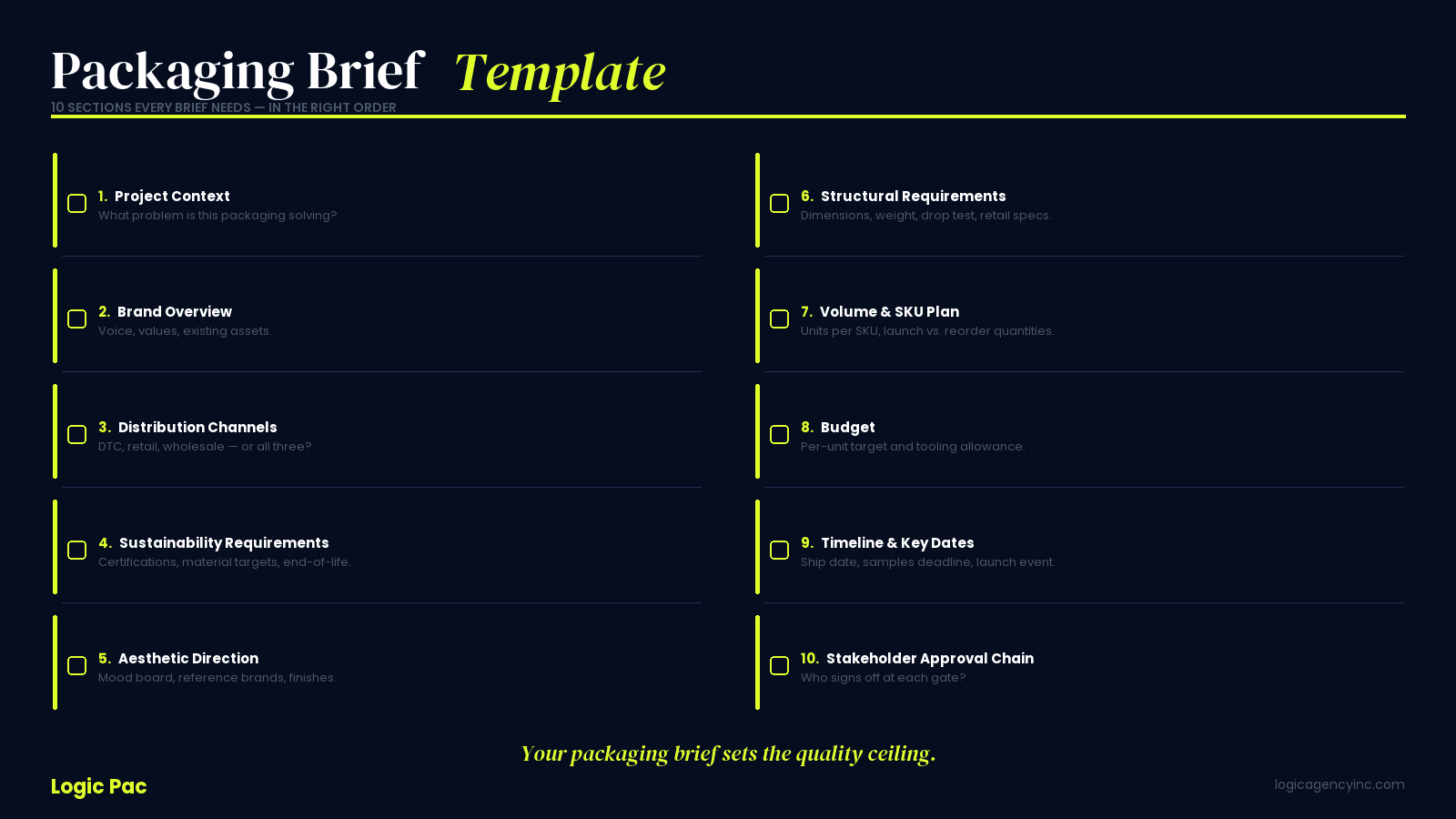
1. Project context & objective
Two to three sentences. What product is this for? What is the packaging meant to accomplish? Hero launch, line extension, retail readiness, sustainability redesign, cost optimization?
2. Brand & product overview
Brand positioning in one paragraph. Product name, formula format, fill volume, in-use application. Link to brand guidelines if available.
3. Distribution channels
DTC only? Retail launch? Wholesale? Multi-channel? Specify retailers if known — Sephora, Target, Whole Foods all have different compliance requirements that need to be designed in from concept.
4. Sustainability requirements
This is now non-negotiable. Specify:
- Recycled content thresholds (e.g., minimum 30% PCR)
- Required certifications (FSC, BPI, Cradle-to-Cradle)
- Mono-material requirements
- Regulatory jurisdictions you're selling into (EU, California, UK)
- Public sustainability commitments the brand has already made
5. Aesthetic direction
Reference imagery from competitors and adjacent categories. Three references is enough — more usually muddies direction. Be specific about what you want to take from each reference and what you don't.
6. Structural & functional requirements
Dimensions, capacity, opening mechanism, dispensing format, child resistance, tamper evidence, special features. Include compatibility with existing components if you're extending an existing system.
7. Volume & SKU plan
Year-1 forecast volume per SKU. Number of SKUs in the project. Whether SKUs share components (and which ones). This determines tooling investment and supplier strategy.
8. Budget
A target per-unit landed cost or total project budget. The most common mistake here is leaving this blank — packaging partners can't optimize against an undefined target.
9. Timeline & key dates
Launch date. Buyer commit dates if retail. Internal go/no-go dates. Sample required dates for retailer presentations or photo shoots. Be honest about what's flexible and what isn't.
10. Stakeholder approval chain
Who signs off on what. Brand approves aesthetics. Ops approves cost and supply chain. Regulatory approves claims and compliance. Founder/CEO if applicable. Knowing the approval chain on day one prevents week-six surprises.
03.The seven most common omissions — and what they cost
| Omission | Where it surfaces | Typical timeline cost |
|---|---|---|
| Channel mix not specified | Week 5–6, when retail compliance gets discovered | +2–4 weeks |
| Sustainability requirements vague | Week 4, when material sourcing changes mid-design | +3–5 weeks |
| Volume forecast missing | Week 7, when tooling decisions surface | +1–2 weeks |
| Budget undefined | Week 6, when first costed samples come in over target | +2–3 weeks |
| Approval chain unclear | Week 8, when sample sign-off stalls | +1–3 weeks |
| Existing component compatibility | Week 5, during structural prototyping | +2–4 weeks |
| Regulatory jurisdictions | Week 9, when print files prep for production | +1–2 weeks |
04.Annotated sample brief
Below is a real (anonymized) brief that produced a 10-week project. The strong sections are short. The detail is where it matters: sustainability, volume, and compliance.
1. Project context. Launch refillable hero serum into Sephora US (Q3 2026), DTC simultaneous. First refillable in our line.
2. Brand & product. Prestige skincare, $68 retail, 30ml fill, lightweight oil-serum. Brand guidelines attached. Existing line is glass + aluminum.
3. Channels. Sephora US (compliance pack attached). DTC e-commerce. UK launch in 2027 — design for EU PPWR readiness from day one.
4. Sustainability. Glass primary (target 50%+ PCR cullet), aluminum cartridge with mono-PE inner liner. FSC-certified secondary carton. No virgin plastic. Soy-based inks. Public commitment to mono-material recyclability.
5. Aesthetic. See attached references — Aësop functional restraint, Augustinus Bader system minimalism. Avoid floral/feminine cues.
6. Structural. 30ml capacity. Twist-off cartridge swap, no tools. Drop-tested for retail handling. Child resistance not required.
7. Volume. Year-1: 80,000 primaries, 220,000 cartridges. Tool investment justified.
8. Budget. Primary landed cost target: $4.50. Cartridge target: $1.10.
9. Timeline. Sephora samples needed Aug 1. Launch on shelf Oct 15. Photo shoot Sept 5. All non-negotiable.
10. Approvals. Brand: J. Marin (CMO). Ops: D. Yoon (VP Ops). Regulatory: A. Petersen. Final sign-off: C. Velasquez (CEO).
05.Bring it to the table on day one
The version above is a clean, fillable template — the same one we use with every new client. Adapt it to your project, then walk us through it in your kickoff. The brief lock is Gate 1 of every project; the more decisions captured here, the fewer surface in week six.
See how a structured brief led to a coordinated 21+ SKU packaging program in the Epicutis case study.
Bottom line
The best brief is not the longest. It is the one that lets the team develop, quote, test, and approve the right package without guessing. If a decision is known, document it. If it is not known, name the owner and deadline for resolving it.
Still Have Questions?
Bring us your brief — even in draft — and we'll review the gaps, suggest the structural format, and route the work in a single working session.
Packaging Brief FAQs
Lock the Brief
Day One
The cost of a 30-minute conversation in week one is approximately zero. The cost of the same decision in week six is two weeks of redesign.