Sustainable beauty packaging: the practical playbook.
A decision guide to materials, claims, product protection, cost, and compliance for beauty brands.
What sustainable beauty packaging actually means
Sustainable beauty packaging is not one material or claim. It is a sequence of decisions about material reduction, recycled content, recyclability, product protection, sourcing, and end-of-life infrastructure. The right option is the one your product, customer, channel, and supply chain can support—and the one your team can substantiate without vague environmental language.
- Start with reduction and product protection before changing materials.
- Treat PCR, mono-material, refillable, glass, aluminum, and fiber as different systems—not interchangeable “green” options.
- Match every environmental claim to documentation for the finished package, not a supplier's general marketing sheet.
- Build compliance review into concept development. Fixing claims and materials after production is slower and more expensive.
Sustainability Is Now a Packaging-System Decision
Material, product protection, sourcing, claims, and recovery have to work together.
The EU, California, and the FTC each regulate environmental claims or packaging in different ways. Several rules enter new phases in 2026, but applicability and enforcement depend on the market, packaging category, and claim. Brands should review claims, certifications, and material records against the official requirements that apply to them.
At the same time, generic “eco-friendly” language is harder to defend. A material choice and its marketing claim must be supported by documentation for the finished package, the markets where it will be sold, and the recovery infrastructure customers can actually access.
This guide is for brand managers who need to make defensible material decisions — without losing the design quality, premium feel, or production timeline their brand depends on.
- The Sustainability Spectrum — where your packaging falls today
- Material Families — what each option actually delivers
- Certifications That Carry Weight — what to specify, what to skip
- The Regulatory Landscape — three deadlines you need to track
- The Claims Hygiene Framework — three questions before any claim ships
- The Mistakes Brands Make — and how to avoid them
- Where to Start — seven swaps that work without redesigning
01.Six Practical Paths—and What Each Asks of the Operation
Most brands talk about “sustainable packaging” as a binary — you either are or you aren't.
The reality is a spectrum. Six tiers, each with different cost, perception, and infrastructure tradeoffs.
| Tier | Description | Cost Premium | Brand Signal |
|---|---|---|---|
| 1. Conventional | Virgin plastic, mixed materials, multi-layer films | Baseline | None — or negative |
| 2. Reduced | Lighter weight, smaller dimensions, less air | −5% to baseline | Quiet; cost-driven |
| 3. Recycled | PCR/PIR content, recycled paperboard, FSC-certified fiber | +5–15% | Mainstream credibility |
| 4. Mono-Material | Single-resin systems (mono-PE, mono-PP, mono-aluminum) | +10–20% | Compliance-ready, recyclable |
| 5. Renewable / Bio-Based | Plant-based plastics (PLA, PHA), molded fiber, sugarcane | +20–35% | Premium-positioned, sustainability-forward |
| 6. Refillable / Circular | Glass, aluminum, refill systems with closed-loop logistics | +30–60% upfront | Category-leading, lifestyle signal |
Where brands typically get it wrong: they jump from Tier 1 to Tier 6 in a single redesign, then can't sustain the unit economics or consumer behavior change required.
The smarter play is a tier-by-tier roadmap. Move from conventional → recycled → mono-material → renewable as your volume, infrastructure, and brand positioning support each step. Refillability comes after you've earned operational confidence in the lower tiers.
02.Material Families
Every beauty packaging decision comes back to material choice. Here's what each option actually delivers.
PCR (Post-Consumer Recycled) Plastic
Plastic processed from consumer recycling streams — water bottles, food containers — back into usable resin.
- Cost: 10–30% premium over virgin, narrowing at higher volumes
- Perception: The most recognized “second life” claim in beauty
- Color performance: Variable; expect tighter QC tolerance and higher reject rates on opaque white or clear formats
- Where it works: Bottles, jars, tubes, caps at 30–100% PCR content
- Verification: Require the resin declaration, recycled-content percentage, chain-of-custody records, and finished-component specification before making an on-pack PCR claim. Our PCR packaging guide covers what 30%, 50%, and 100% PCR actually costs and requires.
PIR (Post-Industrial Recycled) Plastic
Plastic from manufacturing waste — trim, offcuts, rejected batches — that never reached consumers.
- Cost: 5–15% premium over virgin
- Consumer story: Less compelling than PCR (“not your old water bottle”)
- Where it works: Internal sustainability metrics, ESG reporting, COGS optimization
- Recommendation: Use PIR where the operational sustainability matters more than the marketing copy
Mono-Material Systems
Packaging built from a single resin family — mono-PE tubes with PE caps, mono-PP jars with PP closures, mono-aluminum systems.
- Cost: Often quoted above a comparable conventional structure; the final difference depends on format, supplier, tooling, and volume
- Why it matters: EU PPWR (effective August 2026) penalizes hard-to-recycle multi-material formats
- Where it works: Tubes, bottles, secondary cartons
- Tradeoff: Limited barrier properties for oxygen-sensitive formulas. See our mono-material packaging design guide for the full engineering breakdown
Glass
Heavier, infinitely recyclable, premium-positioned by default.
- Cost: 20–50% premium over plastic, plus higher freight (DIM weight + breakage)
- Where it works: Serums, hero SKUs, refillable systems, fragrance
- Tradeoffs: Freight emissions can negate sustainability gains on high-volume DTC; requires heavier secondary packaging to prevent breakage
Molded Fiber
Made from post-consumer or post-industrial paper pulp, reformed under heat and pressure into custom shapes.
- Cost: Custom mold tooling $5K–15K upfront; per-unit 15–30% premium over corrugate
- Lead time: 8–12 weeks (vs. 4–6 for standard cardboard)
- Where it works: Inserts, structural protection, e-commerce mailers, premium boxes
- Verification: Confirm fiber source, additives, coatings, and the recovery pathway for the finished component.
Refillable Systems
Closed-loop packaging where the customer purchases a primary container once and refills it.
- Cost: 30–60% premium upfront on the primary; refill economics improve over time
- Where it works: Hero SKUs with high repurchase frequency (foundation, fragrance, deodorant, lipstick)
- Where it doesn't: Trial-stage products, low-repeat categories, brands without refill-return infrastructure
- Honest read: Refillability only delivers environmental benefit when customers actually refill. Under 40% adoption, the carbon footprint can be worse than single-use due to heavier primary packaging.
Plant-Based Inks
Inks derived from soy, corn, or sugarcane instead of petroleum.
- Specification: Ask the printer for the ink formulation, VOC documentation, and compatibility with the selected coating and recycling pathway.
- Tradeoff: The ink alone does not determine recyclability; substrate, coating, adhesive, and local processing also matter.
- Cost: Negligible premium for most applications
03.What to Verify Before You Repeat a Sustainability Claim
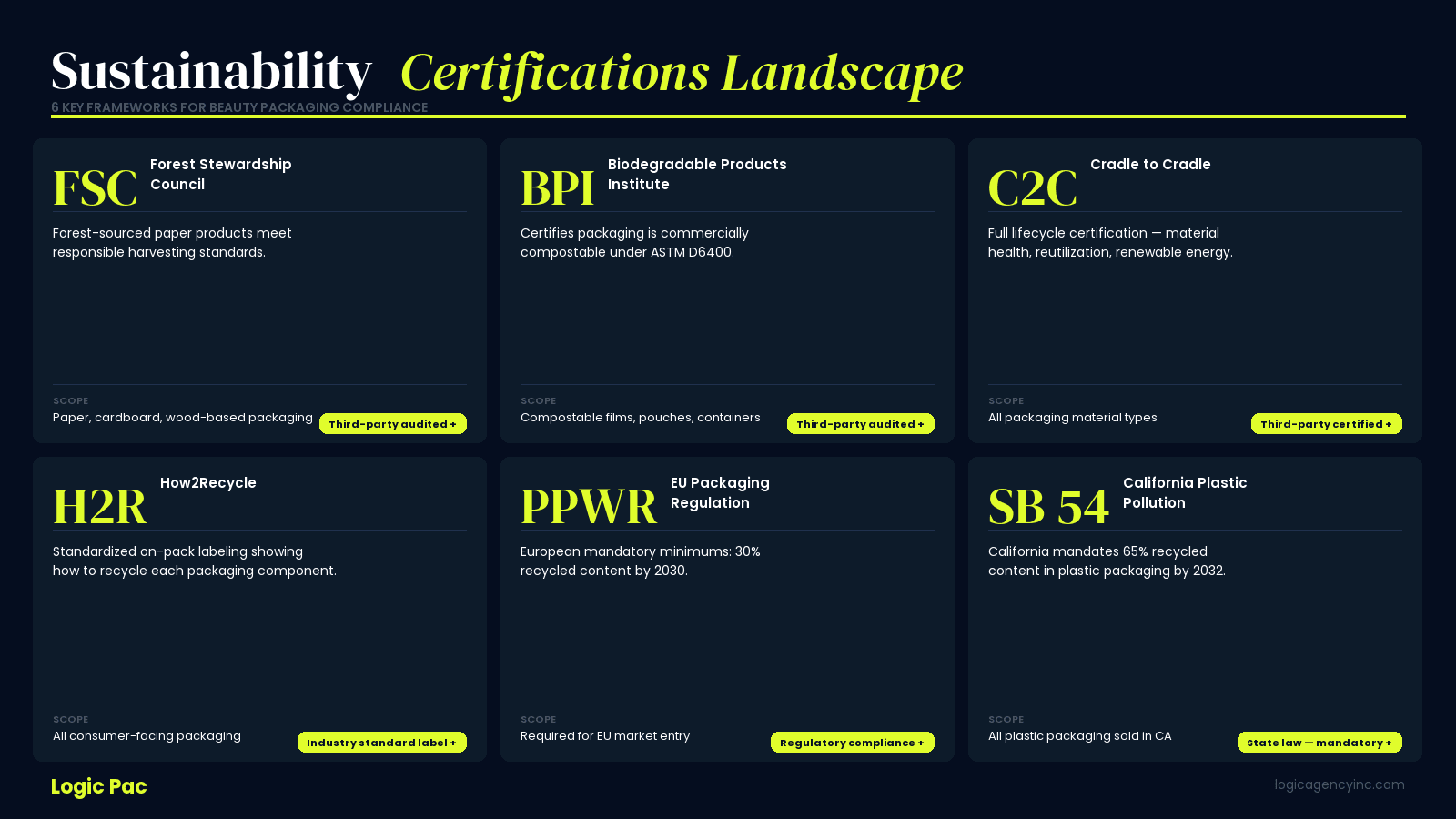
Certifications protect your brand from greenwashing exposure and signal credibility to buyers, retailers, and regulators. Not all of them carry equal weight. Here's what to specify, what to skip.
FSC (Forest Stewardship Council)
Certifies paper, cardboard, and fiber-based packaging sourced from responsibly managed forests.
- What it verifies: Certified material is traced through an FSC chain-of-custody system.
- Use it on: Eligible cartons, secondary packaging, molded fiber inserts, paper labels, and other fiber components.
BPI (Biodegradable Products Institute)
Certifies eligible compostable products against ASTM-based requirements for commercial composting. Certification scope and current standard version should be checked for the specific item.
- Standard: ASTM D6400 and related requirements used by BPI for eligible products and packaging.
- Use it on: Compostable wrappers, refill pouches, mailer fills
TUV / DIN-Geprüft
European compostability and biodegradability certifications. More credible internationally than the term “biodegradable” alone.
- Standard: EN 13432 (industrial composting), OK Compost HOME (home composting)
- Use it on: Anything sold into EU markets making compostability claims
Cradle to Cradle Certified
Multi-attribute certification covering material health, recyclability, renewable energy, water stewardship, and social fairness.
- Tiers: Bronze, Silver, Gold, Platinum
- Use it on: Hero SKUs, brand-defining packaging, when sustainability is a primary brand pillar
What to skip
- Generic “green” or “eco” graphics with no certifying body. The chasing arrows symbol alone is now restricted in California.
- Self-declared certifications. Anything you certified yourself isn't a certification.
- Carbon-neutral claims that rely solely on offsets without emissions reduction.
04.Where Claims, Materials, and Market Access Intersect
Several packaging and environmental-claims rules enter new implementation phases in 2026. The requirements differ by jurisdiction, product, packaging category, and claim, so brands should verify the applicable text rather than treat them as one deadline. For a side-by-side orientation across SB 54, SB 343, Prop 65, FTC Green Guides, MoCRA, EU PPWR, and more, see our beauty packaging claims & compliance guide.
EU Packaging and Packaging Waste Regulation (PPWR)
Effective: August 12, 2026
Introduces packaging-minimization, recyclability, labeling, and recycled-content requirements across the EU. Under Article 7, the 2030 minimums depend on packaging category:
- 30% for contact-sensitive packaging whose main component is PET
- 10% for contact-sensitive plastic packaging made from plastics other than PET
- 35% for plastic packaging outside the specified contact-sensitive and beverage-bottle categories
- Design-for-recycling requirements apply on the regulation's phased timetable
Impact on beauty: Multi-layer films, mixed-material bottles with PET bodies and PP caps, and decorative metallic coatings will face higher EPR fees. Mono-material systems will become the cost-efficient default.
EU Empowering Consumers for the Green Transition Directive (ECGT)
Effective: September 27, 2026
Bans generic green claims across all EU member states. Specifically prohibits:
- Unqualified “eco-friendly,” “green,” “sustainable” claims
- “Climate neutral” claims based solely on carbon offsets
- Sustainability labels not backed by a public authority or certification scheme
Impact on beauty: Every claim on-pack and in marketing copy needs substantiation.
California SB 343 (“Truth in Recycling”)
Effective: October 2026 (full enforcement)
Bans the chasing arrows symbol and the word “recyclable” on any package not accepted by 60%+ of California's residential recycling programs.
Impact on beauty: Most flexible films, multi-layer pouches, decorative caps, and small-format components no longer qualify for the recyclable claim in California.
FTC Green Guides
Already actively enforced:
- Unqualified “biodegradable” claims must support full decomposition within one year of customary disposal — anything destined for a landfill cannot legally be marketed as biodegradable without qualification.
- “Recyclable” claims require a substantial majority (60%) of consumers to have access to recycling. Below that threshold, the claim must be qualified.
05.The Claims Hygiene Framework
Before any sustainability claim goes on-pack — or in marketing copy — run it through this three-question test.
Question 1: Is it specific?
“Eco-friendly” is not specific. “Made with 50% post-consumer recycled PET” is.
| Vague claim | Specific replacement |
|---|---|
| “Eco-friendly packaging” | “Made with 50% PCR plastic, FSC-certified outer carton” |
| “Sustainably sourced” | “FSC-certified paperboard from responsibly managed forests” |
| “Biodegradable” | “Industrially compostable per ASTM D6400 (BPI-certified)” |
| “Recyclable” | “Recyclable in curbside programs in 60%+ of US municipalities” |
| “Carbon neutral” | “Carbon footprint reduced 40% vs. previous generation; remaining emissions offset via verified registry” |
Question 2: Is it substantiated?
Every claim needs backing documentation a regulator could request and review.
- Recycled content percentages → supplier certificates of analysis
- Compostability claims → BPI or TUV certification numbers
- Carbon claims → third-party verified lifecycle assessment
- Recyclability claims → infrastructure access data (How2Recycle, RecyclerNetwork, or equivalent)
If you can't produce the documentation in 24 hours when asked, the claim isn't substantiated.
Question 3: Is it jurisdictionally safe?
A claim that's defensible in the US may not be in the EU. A claim that holds in California may not in Texas.
- For US national distribution: meet FTC Green Guides standard (substantial majority access)
- For EU distribution: meet ECGT specificity + substantiation requirements
- For California: meet SB 343 chasing-arrows restrictions
- For multi-market: default to the strictest jurisdiction's standard
The brands that get this right design once for the strictest regulator and ship that version everywhere. It costs slightly more upfront. It saves significantly more in legal exposure and rebranding cycles.
06.The Mistakes Brands Make
Patterns we see repeatedly. All of them avoidable.
Mistake 1: Switching plastic to paper without lifecycle math
Paper feels more responsible. But it's heavier, generates more freight emissions, and ends up in landfills at similar rates to plastic. A corrugated mailer that weighs 40% more than a poly mailer creates more transport emissions, even if it's “recyclable.”
Fix: Run lifecycle math before material swaps. Sometimes the more sustainable choice is reducing total material, not switching material families.
Mistake 2: Specifying “compostable” without checking infrastructure
Compostable packaging only delivers environmental benefit if it reaches a commercial composting facility. Most US municipalities don't accept compostables in residential streams.
Fix: Check whether your customer base actually has composting infrastructure. If they don't, “compostable” is a marketing claim with no environmental payoff.
Mistake 3: Using PCR percentages as a marketing arms race
Brands compete on PCR content (50% becomes 70% becomes 100%) without checking whether the supply chain can actually deliver consistent quality at higher percentages.
Fix: Match PCR content to your QC tolerance and consumer perception threshold. A consistent 30% PCR with reliable color matching outperforms an inconsistent 100% PCR with reject rates in the double digits.
Mistake 4: Treating sustainability and luxury as opposites
The myth that eco = drab is over. Molded fiber feels premium. Mono-material aluminum looks luxury. Refillable systems signal status.
Fix: Brief your designers and suppliers explicitly on premium-AND-sustainable. The materials and finishes exist; you just have to specify them.
Mistake 5: Ignoring secondary and tertiary packaging
Most sustainability initiatives focus on the bottle or jar. Secondary packaging (cartons, inserts, mailer boxes) and tertiary packaging (cases, pallets) often have larger total environmental impact.
Fix: Apply the same scrutiny to every layer.
Mistake 6: Making claims you can't substantiate
The most expensive mistake. Generic “eco-friendly” graphics, vague carbon claims, sustainability badges with no certifying body. Each one is now legal exposure under the EU ECGT, California SB 343, and FTC Green Guides.
Fix: Audit every existing on-pack claim against the three-question test in Section 5. If a claim doesn't pass, remove it or replace it with a specific, substantiated alternative.
07.The Lowest-Drag Improvements to Assess First
Seven changes that deliver immediate impact on most existing packaging systems — without a full redesign.
Swap 01 Switch outer cartons to FSC-certified paperboard
Lowest-friction, highest-credibility move. FSC certification is widely recognized, the cost premium is modest (5–10%), and the supply chain is mature.
Swap 02 Increase PCR content in your existing plastic components
Most resin suppliers can deliver 30–50% PCR in standard PET, HDPE, and PP without retooling. Start with secondary components (caps, closures) where color tolerance is higher.
Swap 03 Replace plastic inserts with molded fiber
For e-commerce mailers, gift sets, and hero SKU boxes. Molded fiber feels premium, provides equivalent protection, and is fully recyclable. Custom mold tooling pays back at 10K+ unit volumes.
Swap 04 Eliminate unnecessary secondary packaging
The most sustainable packaging is the packaging you don't use. Audit whether your secondary cartons, tissue layers, and inserts are actually serving a function — or just adding material.
Swap 05 Switch to plant-based inks
Soy or sugarcane-derived inks reduce VOC content by over 80% versus petroleum inks. Most printers can switch with minimal cost impact.
Swap 06 Migrate multi-material systems to mono-material
Where formulation tolerances allow, shift mixed-resin systems to mono-PE or mono-PP. Better recyclability scores, lower EPR fees under EU PPWR, simpler supply chain.
Swap 07 Audit your claims library
Before any of the regulatory deadlines hit in late 2026, audit every on-pack claim, marketing claim, and website claim against the three-question framework. Remove vague claims. Replace with specific, substantiated alternatives.
The Artilect packaging reduction case study shows this approach applied to a real program — removing material and complexity while protecting the customer experience.
Bottom Line
The strongest sustainability move is rarely the most dramatic one. It is the change that reduces material or improves recovery without compromising the formula, shelf life, customer experience, or production plan. Make the claim only after the package and its documentation can support it.
Sources
Regulatory and certification sources verified as of .
Primary regulatory and certification sources used for the claims in this guide. Cost and lead-time ranges are Logic Pac operating guidance and vary by specification, volume, and supplier.
- EUR-Lex: Directive (EU) 2024/825 — environmental claims, sustainability labels, and application from September 27, 2026.
- EUR-Lex: Regulation (EU) 2025/40 (PPWR) — recyclability, recycled-content, labeling, and packaging-minimization requirements.
- CalRecycle: SB 54 Packaging EPR — covered materials, producer obligations, regulations, and implementation resources.
- FTC: Environmental Claims and Green Guides — recyclable, compostable, degradable, and general environmental-benefit claims.
- FSC: Chain of Custody Certification — requirements for tracing FSC-certified material through the supply chain.
- BPI: Compostable Products Standard — certification tied to ASTM compostability standards.
- Cradle to Cradle Products Innovation Institute: Certification Standard — material health, circularity, climate, water and soil, and social-fairness criteria.
Pressure-Test the Packaging Decision Before You Brief Suppliers
If you are comparing materials, claims, or refill formats, we can help map the tradeoffs against your product, channel, quantities, and timeline. You will leave with a clearer direction—even if the right answer is to change less than expected.
Still Have Questions?
Here are the most common questions we get about sustainable beauty packaging. If you don't see your question, book a call and we'll give you a straight answer.
Sustainable Packaging FAQs
Make Sustainability
Defensible
The right material, the right claim, the right certification — in every jurisdiction you ship into.